Enhancing Property Sales: How 3D Rendering Transforms Real Estate

3D rendering in real estate helps properties sell by giving buyers a clear, true-to-life picture of a home before they visit, or even before it’s built. Buyers see the layout, light, and finishes at a glance. That clarity leads to more tour requests, faster decisions, and stronger offers because buyers stop guessing and start picturing their life in the space. Most buyers judge a home on a screen first. If the images are dark, empty, or confusing, they scroll past. A good 3D render fixes that problem in seconds.
What Is 3D Rendering in Real Estate?
3D rendering turns plans, drawings, or a computer model into images that look like real photos. An artist builds the home on a computer, adds materials, furniture, and daylight, and then exports still images, 360-degree views, or short videos.
It works for homes that exist and for homes that are still on paper. A builder uses 3D visualization to sell a condo tower that is only a hole in the ground. An agent uses 3D rendering to fill an empty living room with furniture.
Artists build these 3D images in tools like 3ds Max with V-Ray or Corona, or in real-time engines such as Unreal Engine. Few agents or builders keep these artists on staff. Work comes in waves, so many developers outsource 3D architectural rendering services for each project instead of paying a full team all year.
How Does 3D Rendering Help Sell a Property?
3D rendering in real estate helps sell a property by giving buyers a clear, realistic picture of the home before they visit. This results in more tours, stronger offers, and faster sales.
Helps Buyers Picture Themselves in the Home
Furnished renders make an empty house feel like a home. According to NAR’s 2025 Profile of Home Staging, 83% of buyers’ agents said staging made it easier for buyers to see a property as their future home.
A render gives buyers that same feeling without renting a single chair. Buyers who picture their own sofa in the living room are already halfway to an offer.
Makes Confusing Layouts Easy to Understand
A clear 3D view shows buyers how a room works. A long, narrow room looks like a hallway in a flat photo. Add a sofa, a rug, and a dining table, and buyers see two usable spaces.
Agents often outsource 3D floor plan rendering services for this exact problem. A top-down 3D plan shows how rooms connect far better than lines on paper.
Raises the Value of Offers
Homes that look move-in ready get better offers. In the NAR report, about 30% of agents said staging raised the value of offers by 1% to 10% over similar homes that were not staged.
On a $500,000 home, even a 1% lift is $5,000. Weigh that number against the price of your renders.
Cuts Time on the Market
Clear images help listings sell sooner. About half of agents in NAR’s survey saw faster sales: 30% of listing agents reported a small drop in market time from staging, and 19% said time on market was greatly reduced.
Fewer days on market means fewer price cuts. When a listing stays up for weeks, buyers start to ask what is wrong with it.
Turns Online Views Into Showings
Strong images turn online browsers into in-person visitors. One in three buyers’ agents said buyers were more willing to tour a staged home they first saw online.
Most buyers decide in a few seconds whether a listing is worth a visit. A well-lit, furnished main image wins that first look.
Reaches Buyers Who Can’t Visit in Person
Renders let out-of-town and overseas buyers judge a home from anywhere. They can study the layout, finishes, and views without booking a flight. This matters most for luxury homes, vacation properties, and new projects marketed to investors. When the images are accurate, remote buyers feel safe enough to reserve or make an offer before they ever step inside.
Which Type of 3D Render Fits Each Property?
The right render depends on the property’s stage and the problem you need to fix. Use this table when planning a listing or a launch:
| Render type | Best for | Problem it solves |
| Exterior still | New builds, unbuilt projects | No building to photograph yet |
| Interior still | Empty or dated homes | Bare rooms look small and cold |
| Virtual staging on real photos | Vacant resale homes | Buyers can’t judge room size |
| Top-down 3D layout | Apartments, odd layouts | Flat 2D plans confuse buyers |
| Interactive virtual tour | Remote or overseas buyers | Buyers can’t visit in person |
| Walkthrough animation | Luxury homes, large projects | Still images can’t show how rooms flow |
| Aerial view | Land, gated communities | Buyers can’t see roads, parks, or amenities |
Start with one strong front view and the rooms buyers care about most. Agents in NAR’s report named the living room, primary bedroom, and kitchen as top rooms to stage. Spend your budget there first.
How Do Developers Sell Homes Before They Are Built?
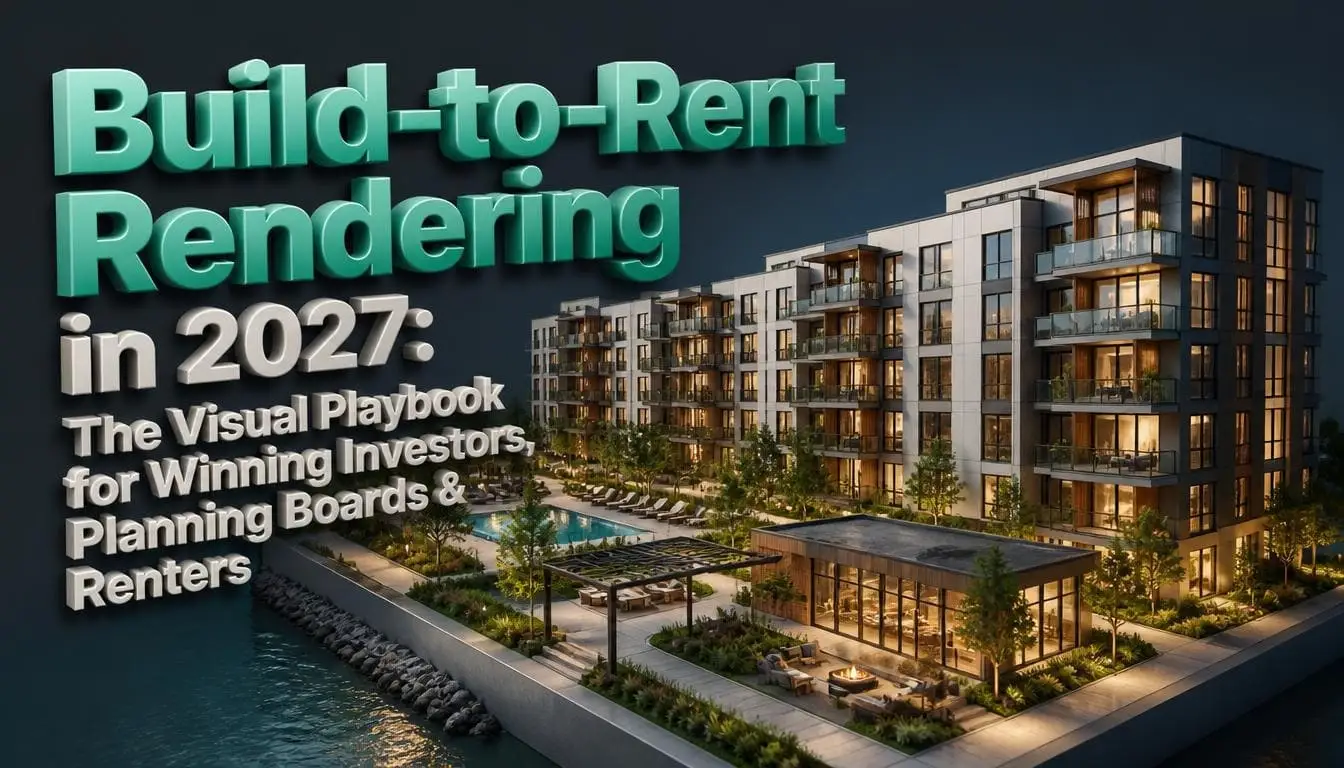
Developers sell homes before they are built by making renders their main sales tool from day one. Buyers reserve off-plan units based on images of the finished building, the lobby, the views, and the units.
This matters more now. According to NAR’s 2025 Profile of Home Buyers and Sellers, new homes rose to 16% of purchases, a level not seen since 2006, and new-home buyers said one reason was the chance to customize design features. Renders let those buyers compare tile, cabinets, and flooring before anything is installed.
A strong pre-construction sales package includes:
- A main exterior view for ads, signs, and the website
- Lobby and amenity views, like the pool, gym, and rooftop
- One interior view per unit type
- Finish options shown in the same room
- A short video for the sales center screen
Most builders outsource 3D rendering services for this package. The launch date is fixed, and the images must be ready long before construction starts. Updating a render after a design change takes days. Rebuilding a model home takes months.
How Much Does 3D Rendering Cost Compared to Staging?
The cost of 3D rendering depends on how many images you need, how detailed they are, and whether the artist starts from photos or from plans. Studios price each image on its own so a small listing and a full tower launch land at very different totals.
These factors change the price:
- Number of views: each still image is priced separately
- Starting point: real photos take less time than building from CAD plans
- Detail level: custom furniture and landscaping add hours
- Format: animation costs more than still images
- Revisions: most studios include a set number of change rounds
- Turnaround: rush jobs cost extra
Use physical staging as your yardstick. National Association of Realtors (NAR) puts the median cost of a staging service at about $1,500, dropping to about $500 when agents stage the home themselves. Rented furniture also has to be moved out. A render is a one-time cost you reuse on the Multiple Listing Service (MLS), social media, flyers, and signs.
What Makes a Render Help a Sale Instead of Losing It?
A render helps a sale only when it is both realistic and honest. Fake-looking images make buyers doubt the whole listing. Images that hide flaws lead to let-down buyers at the showing.
Buyers already arrive with high hopes. NAR found that 58% of agents saw buyers disappointed when homes did not match what they saw on TV. A render that oversells the home makes that gap worse.
Check every image before it goes live:
- Light comes from the real window direction
- Furniture matches the true room size
- Finishes match what is installed, or are labeled as options
- The camera is at eye height, with no extra-wide lens that stretches rooms
- Window views match the real site
Honesty is also a rule, not just good manners. The NAR Code of Ethics (Article 12) requires agents to present a true picture in their ads, and many local listing services require a label on digitally staged photos. Post the original photo next to the staged one. Never erase fixed features like cracks, power lines, or a neighbor’s wall.
Final Thoughts
3D rendering is worth it for most vacant, new, or hard-to-picture properties. 3D rendering in real estate works because it removes guesswork. Buyers see the space, trust what they see, and act sooner. Pick the render type that fits your property, keep every image honest, and track the results.
Frequently Asked Questions
Q1: Is 3D rendering the same as adding furniture to listing photos?
No. Adding furniture to photos is one use of 3D rendering, but rendering covers much more. Artists also build full exteriors, interiors, aerial views, and videos from plans for homes that don't exist yet. Furnished photos help empty resale homes. Full renders help builders, developers, and agents sell new projects before the first wall goes up.
Q2: Do buyers trust rendered images?
Buyers trust renders that look real and match the home they visit. Trust breaks when images use fake light, oversized rooms, or hidden flaws. Label digitally staged photos, show the original photo next to it, and keep finishes accurate. Honest renders build trust before the showing, so buyers arrive ready to make a decision instead of hunting for problems.
Q3: Can 3D rendering help sell a home that already exists?
Yes. For an existing home, artists add furniture to empty rooms, show a dated kitchen with new finishes, or turn a confusing layout into a clear top-down view. This helps vacant homes, rentals, and fixer-uppers most. Buyers see what the space can become, not just what it looks like on the day the photos were taken.