4D Construction Visualization — Animating the Build Sequence for Stakeholders
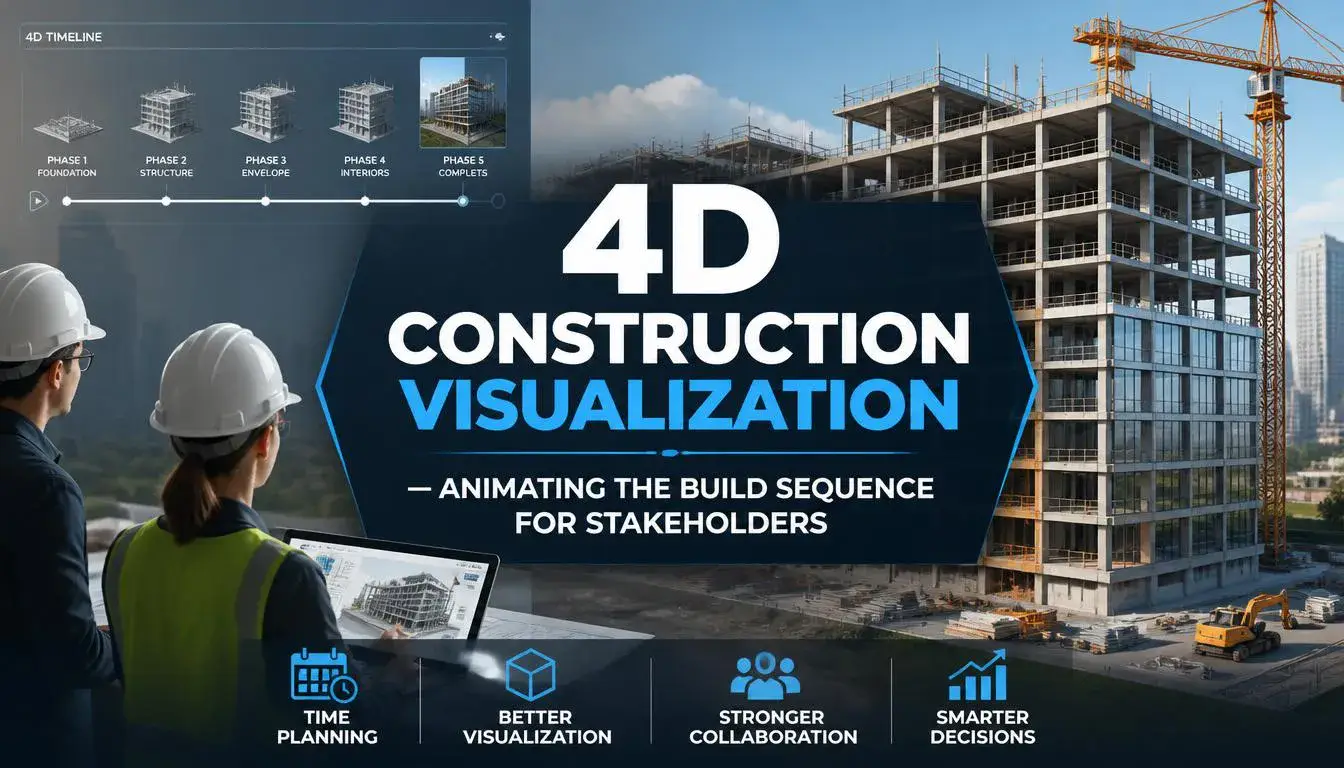
4D construction visualisation promises to increase the reality in the form of images and animation. Compare two things in which investors and architects are sitting in a boardroom who cannot read a Gantt chart. Instead of reviewing the spreadsheet rows, you simply press play on a video that shows your entire project. Which is better? The video. Your foundation appears first and then the structural column rises with MEP systems through floors, etc. This is what 4D construction visualization offers.
It combines time into a 3D building information model and creates an animated simulation. It shows the building sequence step-by-step. Moreover, it transforms abstract schedules into digital stories. This shift is extremely important in the current design industry. Otherwise, guesses and simple 2D drawings result in costly delays and confused coordination among team members. The companies that are using 4D BIM strategically are winning contracts and resolving coordination conflicts months before they reach the site.
DON’T LET GAPS SLOW DOWN YOUR NEXT PROJECT. STICK TO THIS GUIDE AND SEE HOW YOU CAN ANIMATE YOUR NEXT BUILD WITH PRECISION
4D Construction Visualization Overview
For better understanding, let us provide you with an overview of 4D construction visualization.
In simple words, 4D BIM links a 3D model to a construction schedule. Here, time is added as the fourth dimension.
The 3D model captures the details of the structure, MEP systems and finishes.
The time or the fourth dimension tells when each element will be built. The result is reliable because the user gets the build sequence.
The major components of a 4D workflow include:
- 3D BIM model is created in Autodesk Revit or SketchUp
- Project schedule mainly imported from Primavera P6
- 4D simulation software like Navisworks and others
- Animation output
The result is played forward or backward or can be paused at any time. The user can view from any camera angle. In short, it is one of the best tools to make the right decisions.
Why Do Stakeholders Need Animated Build Sequences?
The old communication method that includes 2D drawings and Gantt charts works consistently to convey the exact design concepts of the clients.
A McKinsey & Company study found that the projects that are using advanced BIM Modeling services are experiencing 25% fewer schedule delays and a 35% reduction in rework costs by providing:
- Intuitive visual narratives that anyone
- Clear demonstrations of phasing
- Compelling presentations that support planning approvals
- Common visual reference points
- Early identification of spatial and sequential conflicts
When the project members can watch the building going up before a single construction work is done. The approval process accelerated. No more design misunderstandings.
Real Mistakes People Make
Despite growing adoption, 4D visualization is frequently misimplemented.
These are the most common and costly errors practitioners make:
Treating 4D as a marketing tool only is not a good approach. Several teams generate polished animation for client presentations. But they never use the model for construction coordination.
They choose the wrong software because they never truly understand its limitations. Real-time construction progress is now an important part of the process. So, always select the software on the basis of its capability.
A 4D animation linked to an outdated schedule can be a risk. When the planned sequence shifts in the field, the model must be revised.
Scaffolding and site cabins are frequently left out of 4D models. It misrepresents how the site will actually look during construction.
Moreover, too much geometric detail creates sluggish simulations.
Decision-Making Factors Before Adopting 4D Visualization
All the projects do not benefit equally from a full BIM 4D modeling implementation. Before performing any action, project teams should look into the following factors:
- 4D delivers the strongest return on multi-phase builds. It includes hospitals, airports, and other places where trade sequencing is tightly interconnected
- Public authorities and investors benefit most from animated sequences that reduce communication friction
- 4D requires accurate 3D models as a foundation. The teams that are less aware of BIM. They struggle to use such tools
- 4D models require skilled personnel and licensed software. The smaller projects may need only a lightweight phasing model
- Three things must be compatible:
- authoring tool
- scheduling platform
- 4D software
- Starting 4D planning at the tender stage rather than in the middle of the construction delivers the greatest benefit
What Challenges Do Users Face?
Even experienced teams encounter serious obstacles when implementing 4D visualization at scale:
- Steep learning curve
- Data synchronization burden
- Software compatibility gaps
- Field team resistance
- Hardware limitations
- Sustaining updates throughout construction
In one case, you can avoid these mistakes completely. By hiring experts for architectural animation services, you can tackle all problems. Experienced visualizers are trained to work under every scenario and with the latest tools. Especially, if you have a small setup, you must get expert opinions to compete in this modern industry.
Conclusion
4D construction visualization has completely changed how the industry communicates the build sequence to stakeholders. When everything is implemented accurately with accurate models and the right software. It reduces delays and cuts rework costs. Companies are more confident than before. But with poor selection, things go around to another corner. Understanding the real challenges and making perfect decisions about when and how to use 4D is the real demand.
FAQs
How is 4D construction visualization different from a regular 3D model?
A standard 3D model shows you what a building will look like. 4D visualization adds the fourth dimension: time. Your models are links to a construction schedule. Project members can look at the building sequence phase by phase.
How are 4D build sequence animations used in stakeholder meetings?
In stakeholder meetings, they’re used to walk through phased occupancy plans. They analyse how everything will be managed, from crane positions to traffic impacts. Contractors use it for workers’ coordination and subcontractors’ onboarding. Moreover, the project owners use it to get planning approvals.