
What is Global Illumination and Why It Matters in Rendering
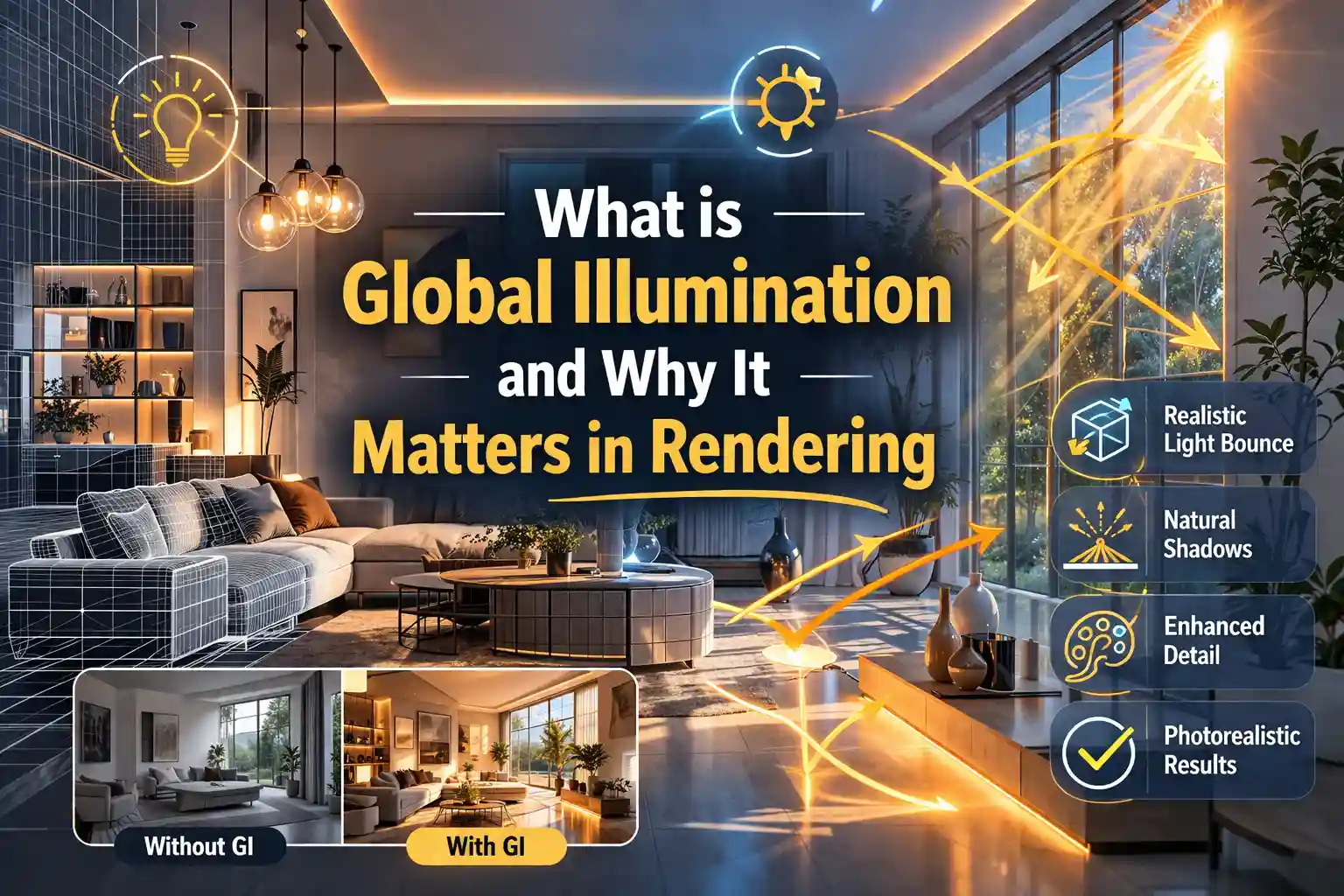
If you have ever looked at a 3D video game or a computer-generated movie scene then you are looking at a global illumination. This has a very big role in the architectural industry. Plus, it is one of the most important and complex ideas in the world of computer graphics.
From architectural designs to famous movies, global illumination is the secret way that makes virtual scenarios like real. In simple words it is about how light behaves in a scene. This means how it reflects and scatters on the surfaces before reaching your eyes. Various investors now get professional 3D rendering services to achieve realistic results and attract new clients to their properties. This way the decisions are made faster with utmost accuracy.
Read our guide to know what Global Illumination is and Why It Matters in Rendering!
What Is Global Illumination?
Global illumination is used in 3D computer graphics to add more realistic lighting to the scenes.
These are the algorithms that consider the light that comes directly from the source. It is also called direct illumination. Plus, it also analyzes how it bounces on the surfaces.
It bounces:
- off the floor
- hits the walls
- bounces again
- gently lights up dark corners
When a light source emits rays that bounce off multiple surfaces before reaching the eye. It is called indirect illumination.
Local illumination, on the other hand, only considers the direct interaction between light and surfaces.
Why Does It Matter?
You need to understand that without the use of this tool, the scenes look flat and artificial.
Here is why GI is so important in rendering:
- GI provides how light travels in nature. It makes scenes look realistic
- The real shadows have soft edges due to the bouncing of light. GI captures this softness. It makes the shadows look natural rather than harsh.
- In case of any red wall next to the white floor. The red color will spread due to reflected light. However, GI handles this effect automatically.
- GI makes indoor scenes feel warm and cozy. It depends on the conditions of the light.
- Without GI, the dark corners of a scene go completely black.
- GI handles glossy floors and rough stone correctly
Some surfaces are not entirely black. They still have some light on them because it bounces from surface to surface.
Every reliable rendering must have global illumination.
It is expensive, which is why most rendering systems have struggled to simulate it accurately.
How Does Global Illumination Work?
There are several techniques used to work GI. Each has its own features:
- Path tracing uses the Monte Carlo method. It generates various rays for each pixel. After that, it bounces in different directions. It creates advanced lighting effects. Plus, it requires various computer resources but it provides stunning results.
- Radiosity divides surfaces into smaller areas. It diffuses the light between them to create a softer look of light bouncing between the objects.
- Probe-Based GI provides real-time performance. It limits the light propagation to diffuse paths for efficiency.
Pre-Computed vs. Dynamic GI
In the past, rendering engines used a baked GI. In this, the lighting is calculated in advance. It is then stored in image files which are also called lightmaps.
This is fast during the runtime, but is not reliable when objects move. The main reason is that the stored lighting data becomes outdated.
On the other hand, pre-computed global illumination is used by expert designers. They apply it over a texture during live rendering.
Dynamic GI calculates light in real time. It is ideal to create real scenarios with moving objects!
Where Is GI Used?
Global illumination is not just for video games. It is widely used across many industries:
It is used in film and in visual effects. Hollywood companies use GI to provide light to the characters and other scenarios.
Architects use GI rendering to show clients how natural and artificial light will look inside a building before it is even built.
It is also used for designing the products. Car manufacturers use GI to render realistic product images for marketing.
Plus, for the best virtual experiences of the scenes. Best lighting is required!
It is also used in medical imaging, which helps in creating accurate visual simulations. It is used in surgical training.
Conclusion
For 3D artists and developers, global illumination is a measure of the realism of the scene. Technologies like ray tracing have a proven record for creating photorealistic results in offline rendering. However, for real-time rendering, simulating global illumination without a lot of computation has been a challenge due to the dynamic nature of the scenes and changing light positions. Recent advancements in technologies and AI are helping to close this gap.