How 3D Technology is Changing the Way We Design Modern Hospitals
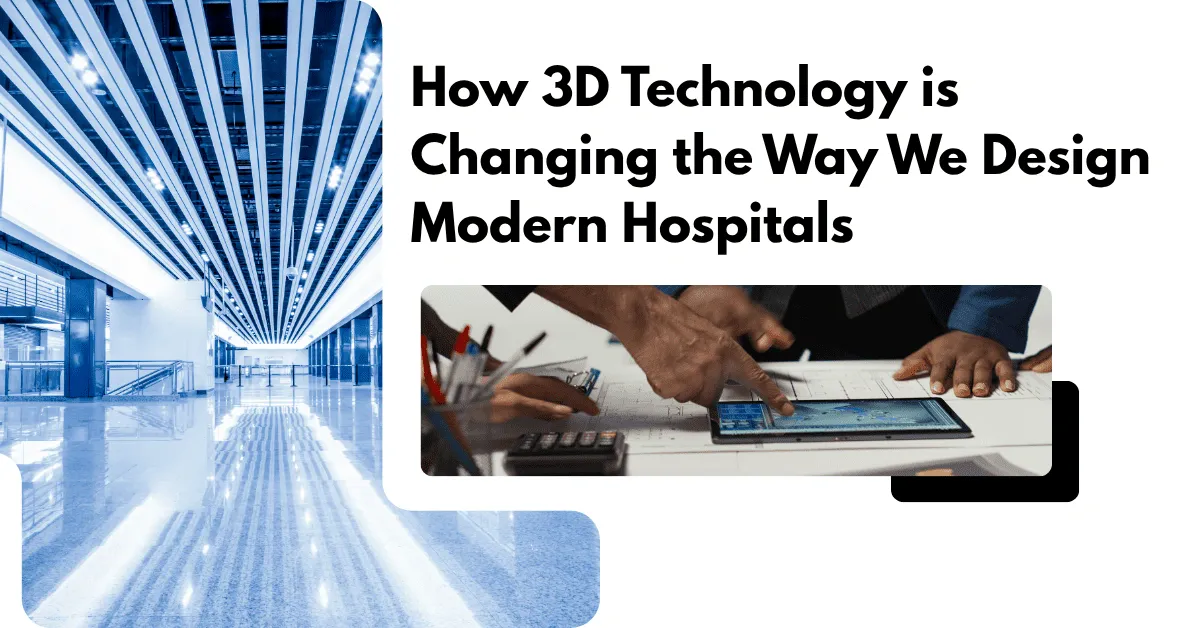
The 3D rendering is revolutionizing the way architects, engineers, and healthcare planners work on the creation of modern hospitals. Hospitals are no longer dressed in technical drawings and just flat blueprints. These days, project teams make use of sophisticated visualization technologies to design real-world clinical settings before breaking ground. For modern health care premises, precision, safety, efficiency,y and comfort are essential. All of these details are significant because hospital needs will impact the quality of patient care and the performance of the hospital’s staff. Using digital technology, healthcare employees can now measure patient flow, lighting, and furnishings.
Overall, 3D architectural visualization in medical construction has changed. Designers can now pinpoint problems at an early stage, coordinate better, and minimize prehistoric construction dangers.
Learn how healthcare facilities have been designed over time, and discover the changing architecture of Healthcare Facilities with SMA Archviz.
The Evolution of Healthcare Facility Design
Over the past ten years, Healthcare facility design has actually come a long way. So now hospitals must not only strive towards medical effectiveness but also towards enhancing the patients’ experience. Healthcare centers are expected to be working, inviting, sustainable, and technologically up-to-date. Modern hospital spaces have to be flexible, even for materials that are capable of preventing infection and smooth circulation systems. Managing all three elements of emergency access, patient privacy,y and operational efficiency is the job of the designer. Conventional planning techniques were unable to effectively cope with such complexity.
The architectural profession has been aided by visualization tools to assess how hospitals perform both before and during construction. This enhances the cooperation amongst healthcare administrators, engineers, and designers. With advanced modeling algorithms, project teams can also see each room in extreme detail and make more informed decisions.
Why 3D Rendering for Hospitals Matters?
Healthcare projects are extremely sensitive, making the demand for 3D rendering continue to rise. Regardless of the message, designers need to be able to convey ideas clearly to stakeholders, medical personnel, and investors. Everyone can have a better grasp of the future building when using Photorealistic rendering. Surgeons are able to be seen in the operating rooms. Nurses have the capacity to study efficiency in the Workflows. Administrators can view the circulation of patients. These visual presentations eliminate confusion and speed the approval process.
Big budgets and tight timelines also characterize hospitals. Costly errors are avoided due to visual changes that occur before the actual construction process begins.
The Role of BIM in Healthcare Construction
The most important innovation in the development of hospitals in the modern age is the use of building information modeling (BIM) in construction. Architects, engineers, and contractors can collaborate inside a virtual world using Building Information Modeling. BIM is better for collaboration as each detail of the project is contained within a single collaborative model. Structural systems, electric networks, plumbing designs, and medical equipment can be tracked in relation to one another by teams.
This technology also improves project efficiency. Pest management involves addressing pest issues before construction starts. Thus, it prevents or minimizes delays and costly errors. The medical world is a complex area with mechanical systems. It must be coordinated correctly for an accurate construction management of the hospital.
VR in Architecture Makes Decisions Better.
Stakeholders have seen a paradigm shift in how they experience their healthcare project with the use of Virtual reality in architecture. Do not come to the provider’s office for paper drawings anymore; clients can now virtually visit a hospital space. It is a virtual tour that helps healthcare teams discover patient rooms, surgical suites, waiting areas,s and emergency departments before the actual construction. This experience helps decision makers assess better how functional the product is and enhances communication in the process.
During the design process, concerns with doctors and nurses can be identified about the workflow. This results in improved operational efficiencies following attribution. VR also helps to build investor confidence in the project as they can truly see what they are getting themselves into.
Digital Twins for Hospital Improves Facility Management
A Digital twin for hospitals is a virtual copy of a hospital. This technology can aid in construction planning and in the long term in operation. Digital twins allow facility managers to monitor building systems, energy performance, and equipment maintenance in real-time. Early detection of problems in their data-driven systems enables hospitals to improve the efficiency of their systems.
This is an added benefit for future renovation projects and expansions. Healthcare buildings are dynamic and continually changing. Digital twins give updated data for improvement. Real-time insights help hospital management with operational data. This leads to informed decision-making.
Evidence-Based Design Supports Care for Patients
There’s an increasing reliance on Evidence-based design principles in modern healthcare planning. The method is based on research and healthcare information for the enhancement of clinical settings. Designers investigate the effect of lighting and noise levels, room layouts, and other spatial arrangements on patient recoveries. The study also found that, in hospitals that are well-designed, less stress and higher patient satisfaction are correlated with higher scores. Patient centered hospital design centers on comfort, ease, and creating conditions that enhance patient welfare. Hospitals nowadays have serene environments, proper navigation directions, and support spaces for patient families.
Patients experience increased safety and comfort while receiving treatment. Efficient layouts also benefit the medical staff, minimizing the need for bending and crouching, as well as enhancing work efficiency.
Healing Environments in Healthcare create a Positive Experience.
The importance of Healing environments in healthcare has become a major focus in hospital architecture. Medical conditions should respond to the emotional as well as the physical healing. Healthy environments include natural materials, quiet interiors, and open spaces. Hospital buildings are no longer seen as a colder institutional building. Instead, designers have designed relaxing environments that can foster a sense of comfort and relaxation.
Biophilic design in hospitals is one of the important strategies. This can be achieved through the use of gardens, daylight, plants within indoor environments, and natural surface finishes. Being in nature can lower stress and the impact on emotional well-being.
Smarter Navigation with Hospital Wayfinding Solutions
Healthcare facilities, particularly those with extensive foot traffic, can be confusing to patients and visitors. Wayfinding solutions for hospitals are effective and enable safe and efficient movement throughout the building. Signage, layouts, and way flowares enhanced. Nowadays, digital models are employed to check the pathways for navigation before construction.
Wayfinding also contributes to the efficient handling of emergencies. During critical situations, medical personnel can move more quickly from one department to another. Thus, it enhances the efficiency of health care institutions.
Optimizing Natural Light in Buildings Improves Wellness
The role of optimizing natural light in buildings is extremely important in healthcare architecture. Natural daylight has a positive impact on the staff’s health, recovery, and happiness. During planning, designers collect and precisely analyse sunlight exposure. The ability to simulate 3D designs will allow architects to view how light will enter the patient rooms, corridors, and waiting rooms during different parts of the day. Corralling the daylight also cuts energy costs since hospitals don’t need to use so much artificial lighting. This leads to better, more sustainable health care workplaces.
Healthcare Pre-Construction Services Reduce Risks
Professional Healthcare provides pre-construction services to project teams to review costs, schedules, and plans to ensure that construction processes are optimized. At this planning stage, hospitals will have strict regulations and complicated systems to take into consideration, so it is very important. Digital visualization tools help you to budget and schedule with accuracy. Construction sequences can be analyzed. Contractors can have insight and can detect risks in the early stages of a building project. This benefits in reducing construction rework, saving time and money.
The construction of a healthcare facility can’t be handled with a sloppy approach. Errors in construction can cause delays in operations and add to the strain on the finances. These problems can be avoided and prevented with early coordination.
Healthcare Facility Master Planning Improves Long-Term Growth
Healthcare forces warrant impartial and rapid developments that hospitals need to be ready for. Healthcare facility master plans are beneficial in developing long-term plans for growth in an organization. Master planning involves assessing the expected patient load, technology requirements, and operational requirements into the future. Healthcare leaders now have a powerful tool at their disposal to analyze development opportunities in the future through advanced visualization. Using planning with an eye toward expansion earlier makes it easier for hospitals to stay flexible. This ensures the success and reduces future renovation problems.
ROI of 3D Modeling in Healthcare Projects
In the healthcare construction industry, the ROI of 3D modeling has a positive impact. Visualization helps minimize design mistakes, which would otherwise cost time and money, while making projects more efficient. Digital models aid in coordinated delivery between teams. Hospitals do not end up with massive construction conflicts, delays in construction schedules, and waste of materials.
Visualization also helps investors’ confidence, as there is a clear vision for the project. Improved communication frequently facilitates both the overall management of approvals and decision-making processes.
Clash Detection in Hospital MEP Systems
Clash detection in hospital MEP is a key feature of digital construction technology in a hospital environment. Hospitals are comprised of extremely complex mechanical, electrical, and plumbing systems. BIM software can detect conflicts between systems even before construction work starts. This will avoid problems with installation and unnecessary field corrections.
Repeated or serious mistakes in coordination cannot be afforded by hospitals as they could lead to failure of their operations. Early clash detection leads to higher safety and reliability, and higher efficiency of the project.
Virtual Walkthroughs for Stakeholders Improve Communication
Virtual walkthroughs for stakeholders are now heavily relying on modern hospital planning. These virtual displays give decision makers an interactive experience of what the future facility will look like. Stakeholders are better able to see room layouts, room equipment positioning, and circulation paths. This facilitates the cooperation between the architect, the doctor, the team,m and the investor.
Presentations to non-technical audiences are also made easier with walkthroughs. Project-based experiences can be used to better understand hospital goals by the hospital board and administrators.
Generative Design for Healthcare Creates Smarter Layouts
Generative design for healthcare is ushering in fresh opportunities in healthcare architecture. This technology translates design options into the algorithm, using performance goals as a basis of analysis. Once designed, systems can automatically produce layouts that maximize space use, staff efficiency, and optimal patient flow. These smart solutions optimize the efficient use of space and the proper functionality of hospitals. AI-driven hospital layouts aid in the exploration of operational patterns and planning strategies. These technologies help make smarter and more efficient healthcare facilities.
A Smart Hospital Infrastructure Shapes Future Healthcare
A Smart hospital infrastructure is the future of healthcare. Of course, modern facilities combine automation, sensor components, and connected systems to better manage operations. The smart technologies control lighting, air quality, security, and energy use without human intervention. Hospitals are more reactive, efficient,t and sustainable.
Technology integration makes patient care better with faster communication and data management among departments.
3D Printing in Construction Supports Innovation
3D printing in construction impacts healthcare architecture. This technology facilitates the prompt fabrication of tailor-made building parts and medical infrastructural parts. 3D printing cuts material waste and makes construction faster. It also enables dynamic architectonic forms, which are not as easily achieved by tradition. With the rapid progress in construction technology, more healthcare projects are adopting the use of additive manufacturing solutions.
Metaverse for Architectural Review Boosts Cooperation
With large healthcare projects, the concept of the Metaverse for architectural review is becoming realistic. Teams can work together in virtual common spaces. Any architect, engineer, or hospital administrator can work on projects from any distance. This facilitates communication among world teams and quickens decision-making procedures. Healthcare planning could soon be a commonplace usage of immersive collaboration environments.
Compliance and Safety in Hospital Design
There are strict safety regulations and healthcare standards that have to be followed for Hospital projects. Care to ensure safety and efficiency in hospital operations by using FGI guidelines for hospital designs. Modern hospitals require ADA compliant hospital layouts that allow for accessibility for all patients and visitors. Planning for access can enhance both the quality of care and inclusiveness.
Life safety code 101 compliance is very important to the safety and preparedness for emergencies and fire protection systems. In critical times, hospitals need to keep patients, staff,f and the public safe. The other big priority is Hospital infection control design. Risk of contamination must be minimized in the healthcare environment by selecting materials, using an isolation system, and ensuring correct ventilation. SMA Archviz is one of the best companies that provides you with accurate and profound services. We are proud of providing high-quality results using modern technologies and proven methods.
The Future of Modern Hospital Design
Technology, sustainability, and human-centered design have ushered in a new era in healthcare architecture. The convergence of advanced visualization tools enhances patient care and streamlines constructions. Digital systems now influence the design of ideas through to the management of healthcare facilities. Visualization technologies are used to create more efficient collaboration, minimize risk, and build smarter medical environments. Experts in SMA Archviz are not only highly creative but also technically precise, offering expertise in modern visualization techniques as well. Our team works with healthcare developers to bring complex concepts to life and make them a reality in the hospital setting.
Conclusion
The use of digital innovation and smart visualization systems is integral to modern hospital design. BIM, virtual reality, digital twins, and 3D rendering are other examples of technologies that are continuing to drive significant change in the healthcare construction industry. These enhance accuracy, minimize project risks, and help deliver better patient experiences. Any hospital in today’s world should do more than just be functional. They have to be comfortable, safe, sustainable, and efficient for operation. Advanced visualization will continue to be a key element in smart hospitals for the medical facility’s needs of the future. With its expertise and advanced software, SMA Archviz ensures successful healthcare projects with precision and confidence.