How AI is Replacing (or Helping) Manual Rendering Workflows
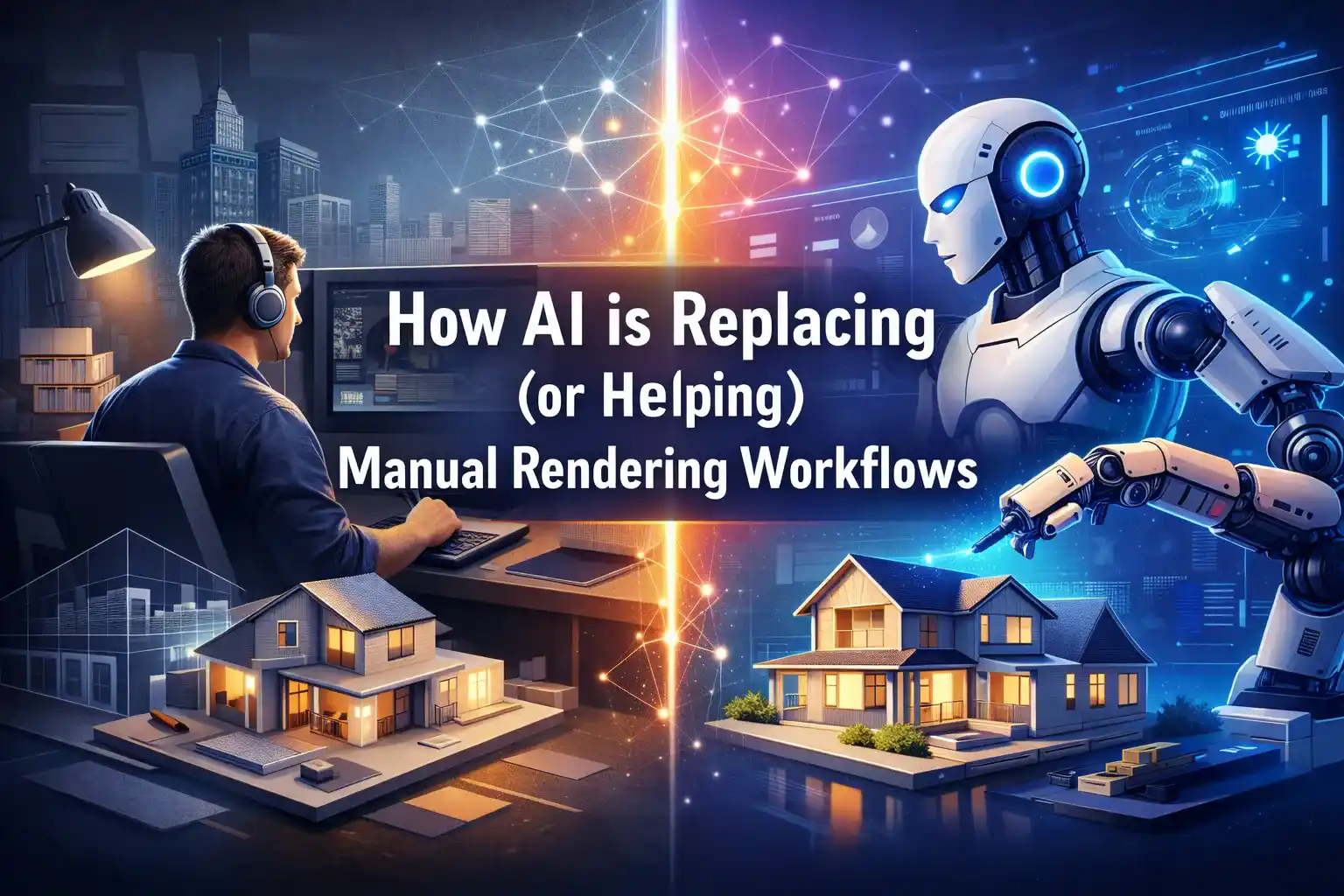
AI is replacing the manual rendering workflow in a very big way. A few years ago, creating a realistic image of the building or the product meant long hours and highly skilled artists. Today, AI is replacing those techniques with advanced methods. The results are enhanced in realistic images and animation in the quickest time possible.
Various rendering companies offer advanced architectural rendering services and a virtual walk-through of the vacant spaces. The expert visualisers add human characters and other details to make the scenario life-like. If you also want to attract new clients to your portfolio, you need to get professional renderings. This way you can increase your profit margins as compared to manual methods and stand out in the industry.
Read our guide to know why AI is Replacing Manual Rendering Workflows!
What Is Manual Rendering and Why Was It So Difficult?
Before AI, the rendering was a detailed and time-consuming process.
The normal workflow for architectural visualisation involved several steps done entirely by hand. It includes multiple complex steps such as:
- detailed 3D modeling with precise geometry
- extensive material setup
- property adjustments
- complex lighting configuration,
- camera setup
- composition
- test renders
- adjustments
However, such workflows require special knowledge at every step! The studios used to spend days and sometimes weeks on a single project.
Moreover, the process required expensive hardware and special software knowledge.
A single mistake in the lighting and material setup means restarting the process from the zero level.
In short, Time is money, and rendering consumes a lot of both.
How AI Is Changing the Game
Speed
One of the biggest changes AI has brought is the speed of the rendering processes.
Advanced rendering tools are used to transform floor plans and sketches into high-quality visualisations.
The designers use it to test the concepts quickly and generate life-like images and animation. They experiment in different styles and present their ideas clearly to the clients. This change in the speed lets designers and architects experiment with new ideas in the quickest time possible.
The best thing about these realistic visuals is that the clients make quick decisions.
Neural Rendering
The major part of this change is neural rendering. It is the combination of learning and normal graphic techniques.
Instead of working on every pixel, it helps to train neural networks. According to the input data, it designs the space.
This allows experimenting with lighting and different textures.
Ways AI Is Replacing or Assisting Manual Workflows
We have provided the areas where AI has made the biggest change
Automated Lighting Setup
Modern AI platforms produce high-quality visuals in seconds with little input. This has increased the speed of the visualisation process.
AI Denoisers as Standard Tools
In professional architectural visualization services, AI denoisers have become standard. These tools clean grainy renders. There is no need to re-run expensive and time-consuming full processes.
Smarter Character Animation
Advanced software has changed the animation processes by training on a source mesh. It has reduced the size by up to 80%.
Animated characters now arrive 40 times faster than they would using traditional workflows.
Intelligent Material Conversion
Software like 3ds Max now also includes an AI layer that converts materials to OpenPBR automatically. It has reduced 40% errors as compared to manual workflows.
AI-Powered Frame Generation
Advanced AI tools also produce up to 3 frames per natively rendered frame.
Smart Asset Management
A Professional architectural rendering company now uses AI to tag and get assets quickly. However, you can search by shape, material, etc.
AI + Human = Best Results
Despite all the benefits of AI, most experts agree that full replacement of human artists is not possible.
The use of AI with humans has become one of the most powerful methods for rendering workflows.
AI rendering tools generally provide support rather than fully replace traditional rendering software.
In simple words, AI tools can be used in the early conceptual stages to quickly generate visuals.
This hybrid workflow combines the speed and creativity of AI with the precision of traditional rendering.
What This Means for Render Studios
One of the common worries is that the faster AI tools mean less demand for render studios. But an interesting thing is that the investment in AI throughout the design increases render volume because faster iteration means more test renders. More test renders mean more total GPU hours.
It offers fewer surprises and cleaner geometry. AI is best suited to speed up the design phase and its benefits are:
- Renders that took overnight are now complete in seconds or minutes
- Visualizations can be generated from remote work. There is no performance degradation over time as hardware ages
- Smaller teams can now handle workloads that previously required large specialist departments
- AI reduces manual mistakes in material setup, etc.
- Artists can focus on storytelling and design rather than technical troubleshooting
- Design decisions happen in real time. It improves collaboration between designers and clients
Conclusion
AI is refining the rendering process. The professional studios that are standing out in the industry have access to the latest AI software. They use it as a coworker to achieve high-quality results in the quickest time. The successful studios are the ones that accept change and plan new methods of working. However, manual rendering workflows were powerful but slow. AI rendering is fast but still benefits from human creative judgment.