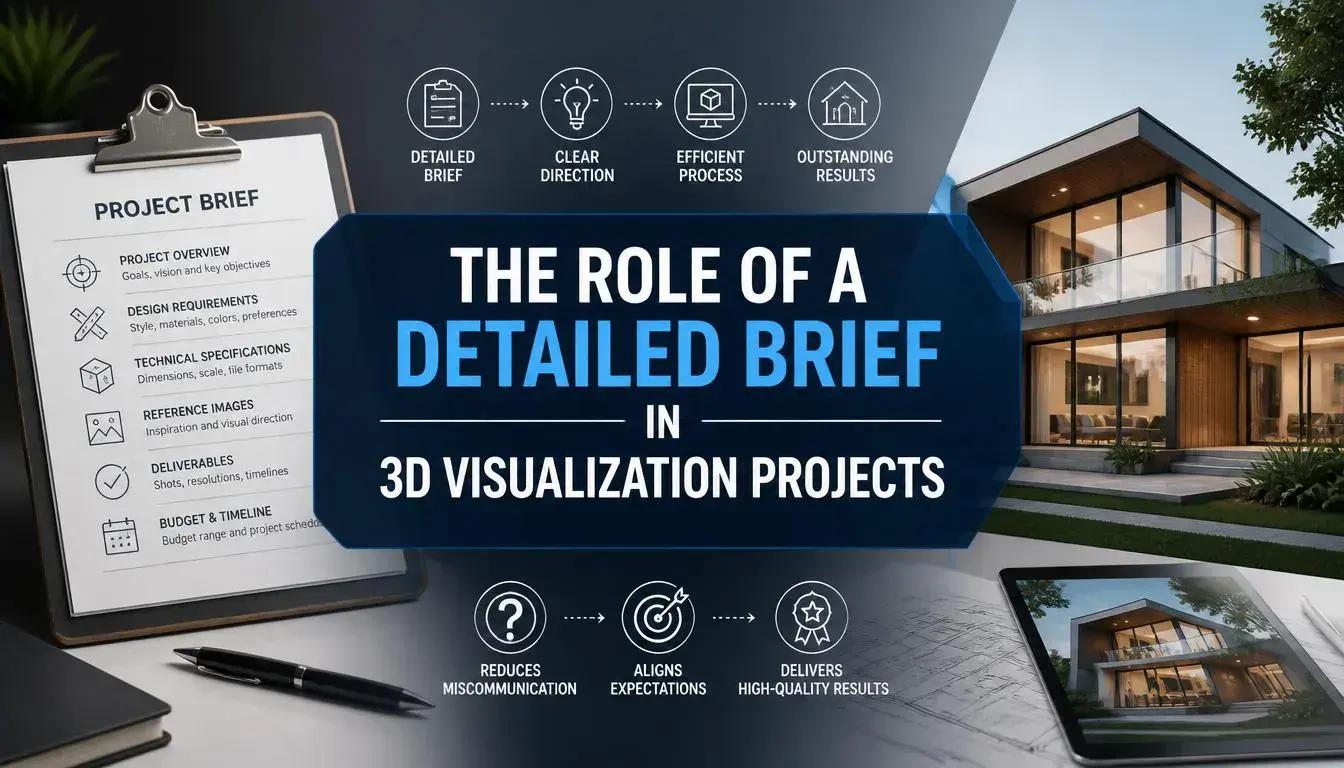
The Role of a Detailed Brief in 3D Visualization Projects
As one of the first signs of this, a Stunning Design may fail to meet the client’s expectations. The developer provided visual content for a new mixed-use project. The design team has provided realistic lighting, material/costuming details, and brilliant camera angles to make for great images. Of course, the work was good technically… The client was, however, disappointed.
The focus on visual elements of the buildings was not a priority. Not much attention was given to important commercial spaces. The landscape was not the same as what was planned. Many revisions took more time and incurred additional costs. The problem wasn’t the quality of the pictures. The issue was already there at the beginning.
This is a scenario that is common in the design and construction sector. Before modeling or rendering, many challenges to visualization lie in the conception itself. If someone is not clear on the expectations, there are likely to be misunderstandings during production. It is for this reason that a detailed brief is one of the most crucial elements in any successful 3D visualization project.
The Importance of Clear Communication in Visualization
Visualization brings an idea to life as a visual experience. These graphics are crucial for the client to assess designs, get approval, impress investors, and market the designs. Throughout the course of architectural and development projects, a pattern of observations develops. Projects that have clearly defined requirements tend to need less revision and can often be approved earlier.
When there are no explicit instructions for a project, the following are common problems that arise:
- Misaligned expectations
- Additional revision cycles
- Delayed delivery schedules
- Increased project costs
- Communication challenges
When project goals are set first, it becomes much more effective to visualize the process.
What is a Visualization Brief?
A 3D visualization brief is a roadmap that presents the process of producing the 3D visualization. The brief conveys project objectives, design focus, technical considerations, and visual aspirations, instead of asking for images.
A comprehensive brief usually consists of:
- Project description
- Target audience
- Design objectives
- Required viewpoints
- Material specifications
- Lighting preferences
- Reference images
- Branding requirements
- Delivery expectations
The more data you provide, the more likely you are to create something that aligns project goal.
Common Mistake: Assuming Everyone Shares the Same Agenda
Making assumptions is probably one of the most common pitfalls in 3D visualization projects. Design intentions are often assumed to be clear to project stakeholders. It seems like these three tools (architectural drawings, mood boards, and verbal discussion) would suffice.
In fact, various people on the same team often can read the same information differently. Aesthetics may be a designer’s first concern. A developer can be solely interested in commerciality. Customer experience can be a key concern for a marketing team. Without a structured brief, they can cause conflicting expectations. This leads to further revisions and delays in the project.
Mini Case Study: First Steps and Next Steps
Imagine that you have two projects to do that are in two residential developments with comparable scope.
Project A: Limited Project Information
The visualization team was handed architectural drawings and a basic brief for developing marketing visuals. Some revisions have been made after the initial draft. There was a need for angle changes for the camera. Materials need modification. The changes in the landscape elements were significant.
The project was provided for review several times until it was approved.
Project B: Comprehensive Brief Development
Stakeholders presented a comprehensive brief before the production depicting the visual aspects of the project, the target market, desired perspectives, environments, and branding goals. The visualization team has a good idea of the expectations of the project. The approval was given without significant changes, and the delivery was as planned. That’s not because of poor software or art. There was a lack of communication.
The Difference between Rendering and Visualization
A lot of project departments employ these phrases interchangeably. The difference between rendering and visualization, however, helps improve parts project planning. The larger concept of making a visual representation of a project is known as visualization. This encompasses concept development, scene composition, storytelling, and communication strategy.
Rendering is one of the technological steps in this process. It transforms digital models into realistic images by applying light, texture, materials, and effects.
A good visualization strategy starts BEFORE you start drawing. A brief is a significant factor in all the stages of development.
How to Minimize Revisions with Detailed Briefs?
One of the major challenges in visualization projects is revision cycles. Despite additional revisions, it consumes resources and time. It could also slow down approval and project marketing efforts. It is clear from industry experience that detailed briefs are associated with fewer changes than those with less detailed requirements.
Detailed briefs help to clarify:
- Visual style preferences
- Design priorities
- Environmental context
- Stakeholder expectations
- Marketing objectives
This transparency enables the production teams to make informed decisions over the project as it happens.
Supporting Better Architectural Rendering Outcomes
Earning great architectural renderings isn’t about the technical aspects of doing it. Good visual content has to convey the desired space experience. This is achieved through the use of lighting, composition, choice of materials, and perspective.
Even with accurate information, if there is no direction or goals, a technically sound image can end up not being what the project requires. Use of a detailed brief offers reliable visuals and ensures that they are suited to the intended narrative.
For example:
- In the case of a luxury residential project, lifestyle imagery could be a key consideration.
- Sometimes, a commercial development focuses on tenant visibility.
- Mixed-use projects focus on pedestrian activity and public space.
These priorities should be in place before production starts.
Selecting the Appropriate Visualization Partner
The other critical thing is choosing the right 3D rendering company. Flexibility in technical procedures is a factor, but not the only factor; there was a value attached to the communication processes as well.
Expert visualization teams demand really in-depth project data before starting production. This will minimize errors and make things work out as desired.
Criteria for judging a key document will focus on:
- Portfolio relevance
- Industry experience
- Communication procedures
- Revision management process
- Technical expertise
Sometimes the collaboration process can account for more of a project’s success than just software alone.
Before-and-After Scenario
Before Using Detailed Briefs
Ineffective communication, verbal communication, or without adequate reference materials, is often a problem that project teams encounter.
Productions are rapid to start, but revisions multiply as the expectations change.
Schedules are difficult to keep and get challenging.
After Implementing Structured Briefs
Project goals are well-stated. Stakeholders bring expectations all in the same direction before production. There is a more efficient approval system. The quality of the visuals gets better as creative decisions are made to meet well-defined objectives. The result is more uniform, faster, and better project results.
If you can, use the Reference Images to help explain what you did and why.
Pro Tip: Include References Visual When Possible
Reference images will assist in communicating style preferences that may not be effectively communicated with words.
Examples may include:
- Lighting examples
- Material references
- Landscape inspiration
- Interior design styles
- Camera composition preferences
Visual references eliminate confusion and ensure creative alignment.
Develop a brief that includes a structured statement of project goals, audience needs, and visual needs before initiating a visualization project.
Implication: Action is the Way
The majority of visualization issues are not actually caused during the rendering process. They start right from the project planning phase and continue throughout the project. Before committing time to the making of a brief, it is very important to invest as much time as possible to ensure effective communication, few revisions, and successful visualization results.
Conclusion
The use of a detailed project brief is often the difference between a smooth visualization process and a frustrating series of revisions. Technology is improving the capability of renderings; now, what is key to successful project delivery is communication.