Nighttime Architectural Rendering: How to Create Stunning After-Dark Visualizations That Sell
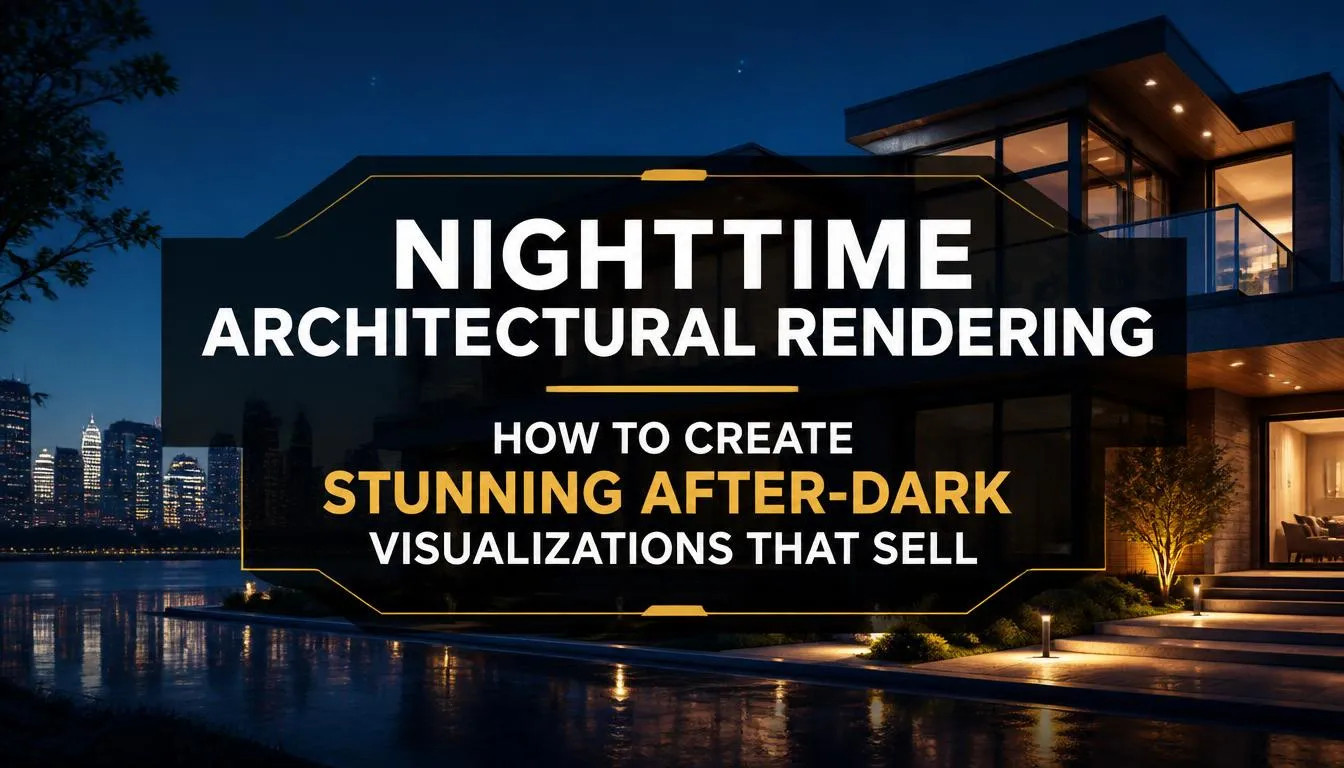
Nighttime architectural rendering lets the client feel the space. This contemporary architectural industry demands stunning after-dark visuals because they are your highest converting assets. These visuals are perfect to sell an atmosphere of luxury that daytime shots cannot match. These renderings compel clients to stop scrolling and say “I want that.”
After-dark architectural visualization has become one of the most powerful tools to market their properties. If you are getting less attention in your Ads or online platforms, then you must get experienced visualization to gain more attraction towards your portfolio.
YOU NEED TO CONVERT YOUR 3D MODELS INTO EMOTIONAL SHOWSTOPPERS BY LEARNING ABOUT PREMIUM AFTER-DARK VISUALISATIONS
Why Nighttime Architectural Renderings Drive Sales
Before understanding the technique, it’s worth understanding why after-dark renders convert.
A night rendering is a CGI that shows buildings with artificial lighting in a nighttime setting. The purpose is to show what the space will look like in real life at night. The visuals are presented in a realistic way that captures a completely different mood than a daytime rendering.
That mood difference is the key. Daytime renders answer the question “What does it look like?”
Night renders answer “How does it feel?”
It is extremely important to feel commercial projects before starting the construction work.
Let us show you why night renders outperform daytime visuals in marketing:
- They create immediate emotional impact through contrast and drama
- Artificial lighting highlights architectural features that sunlight washes out
- They communicate the lifestyle and ambiance of a space, not just its geometry
- They stand out in crowded real estate listing portals and social media feeds
- They demonstrate lighting design intent to developers and municipal planners
Understanding Light Sources in Night Renders
The major and most important skill in nighttime architectural rendering is lighting setting. It shows how they interact with the materials.
Proper lighting and shadows give depth to the scene. Use global illumination and HDRI maps. It copies how light bounces off surfaces.
Every professional night render uses a layered lighting approach:
1. Primary light sources:
- HDRI sky domes with deep blue or violet twilight gradients
- Moonlight
- Urban ambient glow from the nearby city context
2. Secondary artificial light sources:
- Window spill light
- Facade accent and uplighting fixtures
- Street lamps, bollards, and landscape lighting
- Vehicle headlights for street-level context
- Signage and LED strip lighting on commercial buildings
3. Accent and practical light sources:
- Pool and water feature illumination
- Soffit recessed lighting
- Fire pits and decorative pendants
Color Science and Palette Strategy
Color temperature is the secret language of nighttime rendering. If you are wrong at this then flat images will be produced.
The core color strategy for night renders:
|
Rendering Zone |
Recommended Colors & Tones | Strategic Purpose |
|
Background & Sky |
Deep Prussian blue (#0A1628), near-black (#080C12), or rich indigo | Defines the backdrop |
|
Warm Interior Zones |
Amber and golden tones | Ideal for residential spaces |
| Cool Exterior Zones | Blue-gray and silver |
Used for glass facades |
| Transition Zones | Mix of warm and cool tones |
Found at window edges |
| Accent Color Pops | Green or amber |
landscape uplighting |
The 2025–2026 Rendering Stack
Architectural visualization in 2026 is not only about generating stills. The team members deliver realistic short films and increasingly VR/AR visualization. Modern visualizing exterior light fixtures are created with the help of advanced software and through BIM models. Competent workflows use special tools rather than simply relying on a single application. The leading software are:
- V-Ray and Corona Renderer
- D5e Render
- Twinmotion
- Lumion
AI visualization tools:
- Veras by Chaos
- Midjourney
- MyArchitectAI and Krea
Step-by-Step Night Render Workflow
Stage 1 — Scene Preparation
- Lock your camera angle
- Choose that angle which a real photographer would use
- Set the time of day for the most dramatic contrast
- Add contextual environment
Stage 2 — Lighting Setup
- Load a blue-hour HDRI sky environment at low intensity
- Place emissive materials inside windows
- Add IES photometric profiles to fixture models
- Test render at low resolution (512–720px) to check lighting
Stage 3 — Material Calibration for Night
- Increase reflectivity on glass and wet pavement surfaces
- Add subtle emissive value to LED strips
- Apply PBR (Physically Based Rendering) materials for all surfaces
Stage 4 — Rendering
- Render at 4K minimum for marketing use
- 8K for large-format print
- Enable denoising to clean up noise without loss of sharp edge detail
- Render separate passes
Stage 5 — Post-Production
- Use Photoshop for compositing render passes
- Apply post-production techniques. It includes color correction, image contrast, etc.
- Include people, vehicles, etc.
Do not repeat these mistakes
Most of the designers are known with the common mistakes but they still repeat them which do not produce realistic results. If you aim to deliver premium 3D exterior rendering then you need to avoid these mistakes:
- Over-brightening the scene
- Using flat ambient lighting
- Ignoring light bleed and spill
- Pure black skies
- Uniform window brightness
- Neglecting reflections
Is there any future of After-Dark Visualization?
Modern rendering software are making it much faster to turn a rough idea into a realistic image. This image or animation is designed according to the clients demands.
Moreover, the world of architectural 3D modeling has completely changed. Advanced visualizations have become essential for designing buildings. Real estate companies use them for marketing projects and selling them faster.
Now that construction costs are increasing and the clients expectations are also like never before. It is important to clearly communicate the design ideas with the realistic visuals before even a single item is bought.
Conclusion
The companies winning the most profitable projects in this current challenging industry are those who invest on the right strategy to grab clients attention. They are selling stories. Nightitme renderings are the most powerful storytelling medium the industry has ever had. You also need to get your grip strong on this smart strategy. That is what sells architecture.