Why Your Architectural Rendering Lost the Bid: The Psychological Disconnect Between Render Aesthetics and Client Decision-Making
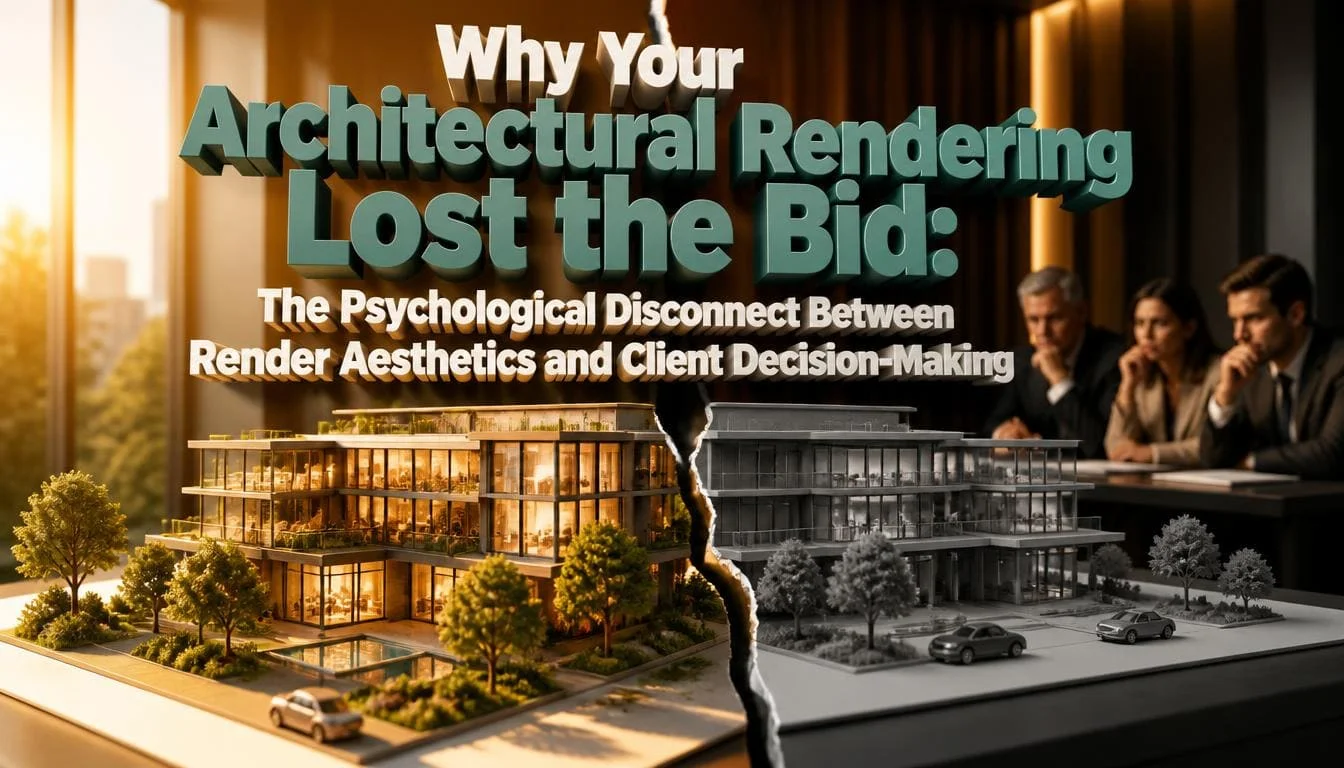
You spent days on a render. The lighting was perfect. The materials looked real. Every reflection was tuned by hand. You submitted it feeling confident. Then the rejection email came. If this feels familiar, you’re not alone. This happens to skilled architects and visualization studios every month. A beautiful, technically flawless image goes out. A “we went with someone else” comes back. No real reason is given, so the same mistake often repeats on the next bid. This article breaks down why your architectural rendering lost the bid, using simple psychology.
We’ll look at how clients actually make decisions, what architectural visualization services get wrong without realizing it, and exactly what to change so your next proposal lands differently.
Are technical flaws really costing you projects? Learn how decision-making psychology affects client choices and transform your 3D visualization strategy to win high-value architectural bids.
Who This Article Is For
This guide is specially written for AEC experts and visualization studios who submit 3D rendering for architecture as part of a pitch or proposal. It is based on decision-making psychology and how presentation design shapes trust before logic even gets involved.
If you’ve ever lost a bid to a “worse-looking” render, this article explains why that keeps happening. At the end, you will get to know what to do about it.
The Real Reason Your Architectural Rendering Lost the Bid
Most people assume rendering quality equals bid success. It is true that more detail and richer materials may win. But that’s not how clients actually decide.
Clients don’t buy images. They buy confidence in an outcome. A render isn’t just a picture of a building. It’s a promise of a future version of the client’s life or business.
When clients look at your renders, they usually think: “Can I trust this render enough to invest my money in it?”
Most people mix up how something looks with how something performs. They feel like the same thing, but they’re not.
Something can look great and still not earn trust. That’s the trap. When you treat “looks good” as the same as “works well,” that’s usually where a strong idea starts to fall apart.
Why Renderings Don’t Win Bids On Aesthetics Alone
Here’s something worth knowing before your next submission. Research from the Nielsen Norman Group on the aesthetic-usability effect shows that attractive design makes something feel more usable and more trustworthy, even before anyone tests it properly. In the original studies, people saw good-looking products with real usability problems as more usable than plainer products that actually performed better.
This might sound like great news for renderers: pretty images win. But that advantage disappears fast if something feels untrustworthy. Even if the materials and lighting are technically perfect. A realistic render with the wrong mood will quickly make clients doubt the project.
So why renderings don’t win bids often comes down to a mismatch. The image is attractive, but it doesn’t answer the client’s real question: “Is this the right space for me, my family, or my brand?”
Rendering Aesthetics vs Decision-Making: A Quick Comparison
| Render Quality | What It Signals to the Client | Does It Win the Bid Alone? |
| Technically perfect lighting | Skilled software use | No, feels neutral without emotional context |
| Photorealistic materials | Attention to detail | No, clients rarely judge materials consciously first |
| Clear human presence in the scene | “I can picture my life here” | Yes, strong trust signal |
| Mood matched to building purpose | “This team understands my project” | Yes, strong trust signal |
| Clean, simple composition | Confidence, clarity | Yes, reduces mental effort, builds trust |
| Overloaded detail, cluttered scene | Confusion, distraction | No, increases doubt |
The Architectural Rendering Perception Gap
There’s a quiet gap between what designers see in a render and what clients see in the same image. Designers look at technique. Clients look at feelings. This mismatch is called the architectural rendering perception gap. It is one of the most neglected reasons which results in rejected proposals.
You might love your realistic lighting and textures. But keep in mind that the client only cares about how the space feels to them. They may see if a kitchen fits their family or if it matches their dream.
What Designers Notice vs. What Clients Notice
| Element | What the Designer Focuses On | What the Client Actually Notices |
| Lighting | Ray accuracy, shadow softness | “Does this room feel bright and happy?” |
| Materials | Texture resolution, PBR accuracy | “Does this look expensive or cheap?” |
| Layout | Technical correctness of scale | “Will my furniture fit? Will it feel cramped?” |
| Composition | Camera angle, rule of thirds | “Can I imagine walking through this?” |
| People in the scene | Realism of human models | “Is this space made for people like me?” |
| Level of detail | How much was modeled | “Is this too busy? What am I supposed to look at?” |
Let us show you the most common gaps:
- Too much polish, less story.
- Wrong emotional tone.
- Overload of detail.
- No visible connection to the client’s brief.
None of these are technical flaws in the traditional sense. They’re psychological ones. And together, they explain a large share of rendering proposal rejection cases that arrive with no clear reason attached.
The Psychology Behind Client Render Selection: How Decisions Actually Happen
Here’s where it gets genuinely useful. Most people believe they choose logically. But decision science tells a very different story, and it directly explains client psychology render selection.
Daniel Kahneman, a Nobel-winning psychologist, described two systems at work in the brain. One is fast, automatic, and emotional. The other is slow, effortful, and analytical. The fast system runs constantly with little effort, while the slower system only activates for effortful tasks like careful comparison. Most everyday judgments, including the first reaction to a design image, happen through the fast, emotional system first.
The Two Systems, Applied to Render Selection
| Fast System (First Reaction) | Slow System (Justification) | |
| Speed | Instant, within seconds | Minutes, after reflection |
| What it judges | Mood, warmth, trust, “does this feel right” | Budget, layout logic, materials, timeline |
| Triggered by | Colors, composition, human presence, lighting mood | Written specs, cost breakdowns, technical accuracy |
| Role in bid decisions | Forms the initial gut preference | Builds the reasons to justify that preference |
| What happens if it fails | Client feels “off” and moves on, often without saying why | Client finds logical reasons to pick a different option |
So if your render doesn’t create the right feeling instantly, no amount of technical accuracy fixes that later in the process. This is a major reason your architectural rendering lost the bid.
What Wins Instead: Fixing the Disconnect
Good news. Once you understand the psychology behind rejection, you can design it without having doubts.
1. Design for the First Three Seconds
Clients decide fast, then justify slowly. Your lead render needs to create instant emotional clarity. Don’t save your strongest emotional image for slide five of the deck. Lead with it.
2. Show Life, Not Just Structure
Empty, lifeless renders feel incomplete. Adding realistic human activity helps clients picture themselves using the space. It builds trust much faster than perfect textures alone.
3. Match Mood to Purpose
A warm family home shouldn’t feel cold like an office. When a space doesn’t match how it’s supposed to be used, people can tell something feels wrong. This mismatch is one of the quiet reasons rendering proposal rejection happens without an explanation ever being given.
4. Reduce Visual Noise
More detail isn’t always better. Too many objects distract from what really matters. Keep the viewer focused on your main design idea, not on a perfectly rendered coffee cup no one asked about.
5. Pair the Image With a Short Story
Adding a simple caption beside key images gives clients a clear reason to love what they see. A short note like “wider windows bring bright morning light into the main living space” bridges the gap between emotion and logic.
Conclusion
Your architectural rendering lost the bid not because your skills were weak, but because the image didn’t speak to how people actually decide. Clients react emotionally first and build logic second. Once you design your renders with this psychology in mind, you stop losing bids for reasons you can never quite see or explain. Great 3D rendering is about understanding the person looking at it, and giving them a reason to trust what they feel.
Frequently Asked Questions
Q1: Does a more realistic render always win the bid?
No. Realism helps build credibility. Clients respond to emotional clarity and trust first. After that, they use technical quality to justify that reaction.
Q2: Why do simpler renders sometimes beat highly detailed ones?
Simpler renders often communicate the main idea faster. A simpler image takes less effort to process. This makes clients trust your design faster.
Q3: How much does presentation order matter in a proposal deck?
A lot, and often more than people expect. Since first impressions form within seconds, the very first image in your deck carries more weight than later, more detailed images that follow it.
Q4: Is losing a bid only about the images, or also how they're presented?
Both matter, and they work together. The render creates the emotional first impression. The surrounding context helps the client justify that impression logically to themselves and to others involved in the decision.