
Deconstructivist Architecture Explained: Key Characteristics and Design Philosophy
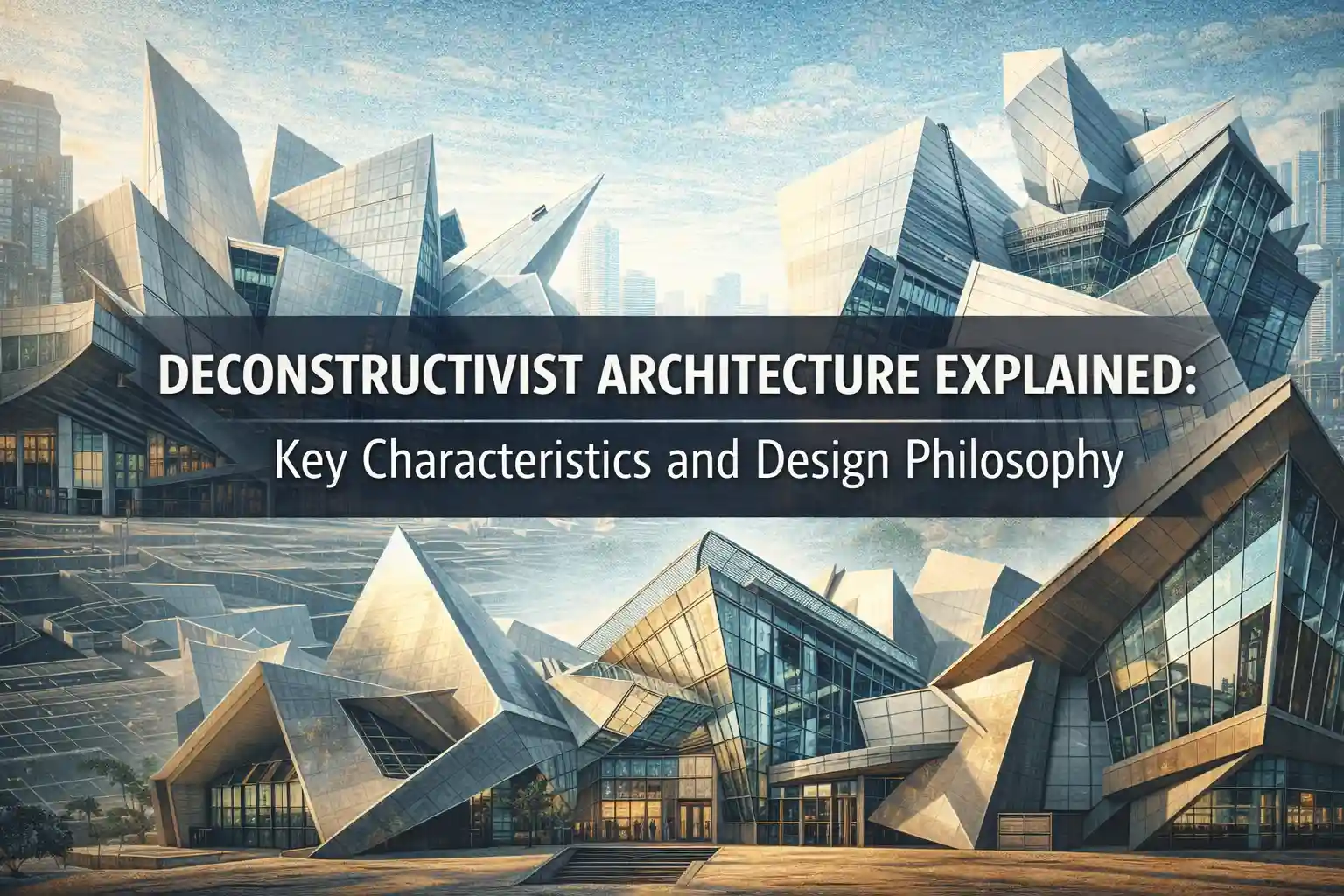
If you have ever seen a twisted building then you looked at Deconstructivist Architecture. It feels like the walls are crashing into each other at certain angles. They look mind-blowing due to their blending of design and complex shapes. It was introduced in the late 1980s. This design threw away the rulebook of traditional design. However, it is not about creating buildings that are in order or provide calm. It is about creating complex buildings.
Commercial building owners and developers experiment with different complex designs with the help of 3D renderings. It provides a clear and real view of the interior and exterior parts of the building. This helps them make the right decisions so they hire the top visualization company and save their budget by making pinpoint decisions.
Learn about an amazing Deconstructivist Architecture with its Key Characteristics and Design Philosophy!
What is Deconstructivist Architecture? A Simple Introduction
The name of this style is a combination of two ideas:
- Construction
- Deconstruction
This concept was developed by the French thinker Jacques Derrida.
For centuries, architecture followed certain rules. It was symmetry and clear shapes. Deconstructivism takes those rules and eliminates them.
The purpose of such designs were providing a broken concept of the buildings. This creates a sense of beautiful and controlled chaos.
Where Did It Come From? A Quick History
The idea of this style became famous in the 1988 exhibition at the Museum of Modern Art (MoMA) in New York.
This show was simply called Deconstructivist Architecture. It included the work of seven famous architects:
- Frank Gehry
- Zaha Hadid
- Peter Eisenman
- Daniel Libeskind
- Rem Koolhaas
- Bernard Tschumi
- Coop Himmelb(l)au
The movement was inspired by two main things:
- Russian Constructivism
A unique design from the early 20th century. It focused on creating sharp shapes that look industrial like.
- Derrida’s Philosophy of Deconstruction
It is a theory that suggests the meaning of any work which is never stable. Architects borrowed this idea to design buildings that break traditional rules and challenge our expectations.
Key Characteristics
Fragmentation
The building looks like it has been broken into pieces. Then it is joined together in an unexpected way. It will not be in a single shape!
Lack of Symmetry
There is no match between the left and right sides. These buildings are imbalanced. Walls are erected at odd angles. They combine to form a clash rather than complement each other.
Distortion and Twisting
The surfaces are bent and twisted. A wall is not flat. It has curves in it in a unique way.
Colliding Forms
It consists of various shapes that touch each other:
- cubes
- spheres
- triangles
Dislocation
The parts of the building feel disconnected from each other.
- A column might not reach the ground
- The window might be placed in a way that seems to ignore the room behind it
Understanding the Design Philosophy
Deconstructivism is not just about making weird-looking buildings for shock value. There is a deep idea behind the design. It’s about questioning everything we take for granted in architecture.
Challenging the Old Rules
Architectural Styles were based on the ideas of order and beauty. There was a famous saying by modernist architect Louis Sullivan: “form follows function”.
This meant that the shape of a building should be based on its purpose. Deconstructivists threw this idea out the window.
They asked, “Why can’t form create new and unexpected functions?”
Creating “Disruption”
The goal is to change the normal way of seeing things. When you look at a deconstructivist building, you can’t immediately understand it.
You have to walk around it and experience it. This is to take us out of our comfort zone and make us see space in a new light.
Famous Examples
Guggenheim Museum Bilbao (Spain) by Frank Gehry
This is one of the most famous examples. It has the following features:
- curved titanium surfaces
- Looks like a big ship
- A right example of fragmentation
Parc de la Villette (Paris, France) by Bernard Tschumi
This is a large park. It is dotted with bright red structures called “follies.” They are in different deconstructed geometric shapes.
Walt Disney Concert Hall (Los Angeles, USA) by Frank Gehry
This is a concert hall. It consists of the curves of stainless steel that reflect light. It makes the building look like it is in a constant motion.
Why Does It Matter Today?
Deconstructivist architecture changed the way architects think about design. It opened new doors for people to use advanced methods. They used them to create complex shapes. It was not possible with manual methods.
That is why people rely on the Best Architectural Rendering Services to design their complex spaces.
Conclusion
In this modern world, the influence of Deconstructivist architecture is seen everywhere. Architecture is more than just providing a roof for anyone. It’s a creative art! It can inspire us and show a different complex nature. One can construct any type of building with unique concepts.