
How 3D Rendering Helps Contractors Visualize MEP Systems Before Installation
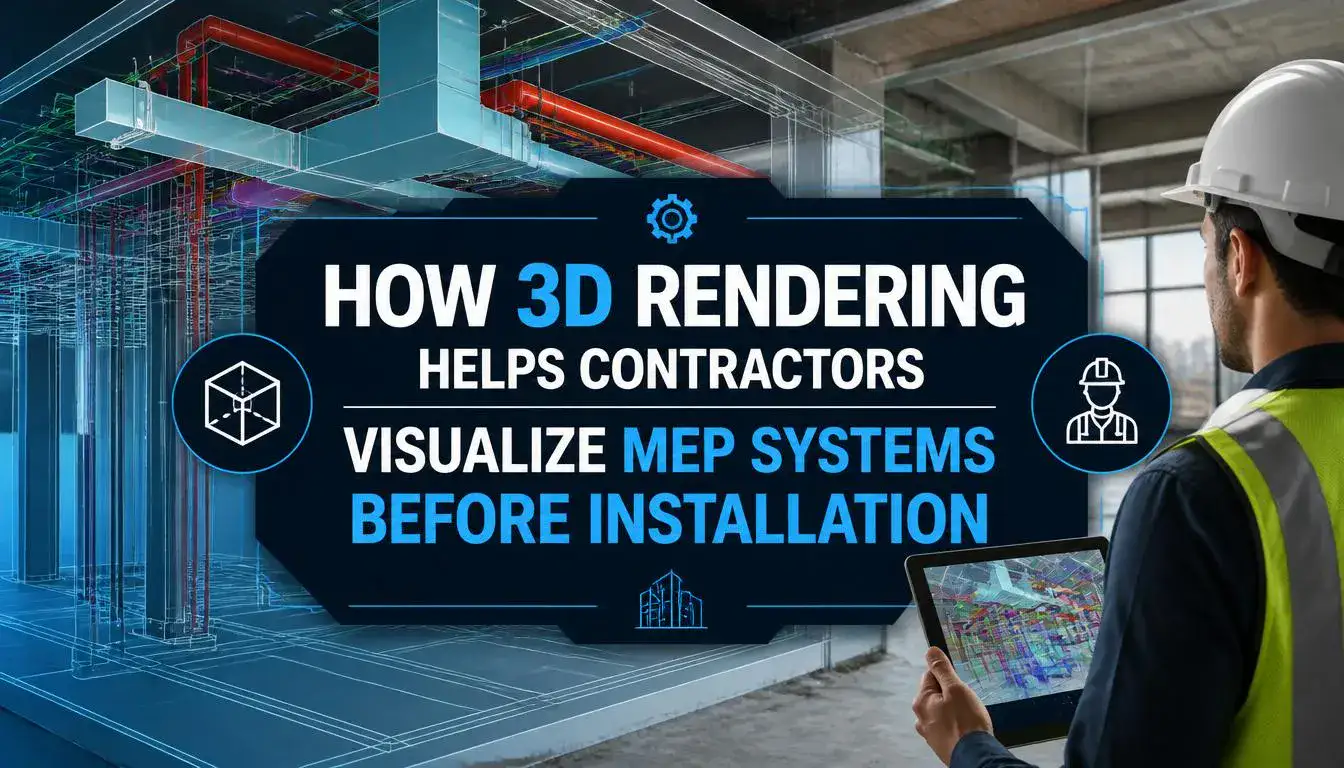
A proper functional building runs on a complex network of invisible infrastructure. Mechanical systems control the air and temperature. Electrical systems adjust every circuit, and plumbing systems that carry water safely in and out. These are combined to be called MEP systems. Moreover, they represent some of the most technically demanding elements in any construction project.
Contractors relied on flat 2D blueprints to plan MEP installations. The result? Costly on-site conflicts and expensive rework. Today, 3D rendering and MEP BIM have totally changed how contractors plan and execute these critical systems. Now, let us tell you about MEP 3D rendering.
What Is MEP 3D Rendering?
It is the process of creating intelligent digital models of a building’s MEP systems using BIM software.
Instead of trying to figure out plain 2D blueprints. Contractors can walk through a realistic 3D virtual model. This shows them exactly where every pipe, wire, and vent will go.
The realistic models are built using the advanced platforms such as Autodesk Revit, D5 Render, and others. This allows MEP engineers and all members to work within a shared digital environment. It resolves conflicts on screen rather than on the job site.
Key Benefits of 3D Rendering for MEP Visualization
1. Early Clash Detection
One of the best advantages of 3D MEP rendering is automated clash detection. When MEP models are merged into a single BIM model. The software tools scan for issues automatically. There are two categories of clashes that get flagged:
- Hard clashes are the physical intersections between components
- Soft clashes are where components don’t leave enough space for installation
According to the industry research, design coordination errors account for up to 52% of all construction rework. This also confirms that BIM reduces rework by 40 to 60 percent on complex projects. So, it is better to get expert 3D rendering services from a reliable company.
The best benefits of clash detection include:
- Identifies issues between HVAC, electrical, and all other systems before installation
- Reduces emergency redesigns
- Eliminates the need for expensive change orders mid-construction
- Improves safety by flagging hazardous spatial conditions in advance
2. Better Installation Planning
Traditional 2D blueprints can never provide you with the detailed information about multiple systems and how they interact in mechanical rooms or congested utility corridors.
3D MEP rendering gives contractors the perfect understanding of what installation will look like.
With the right 3D model, installation teams can:
- Visualize routing paths for HVAC ductwork, piping systems, and electrical conduits simultaneously
- Determine the correct installation sequence so that no trade blocks another’s access
- Identify tight spaces where specialized equipment or techniques will be needed
- Plan for maintenance access points that code requires but 2D plans often overlook
- Simulate construction phasing and 4D scheduling to eliminate scheduling conflicts between trades
3. Supporting Prefabrication
3D MEP rendering is considered the best option for modular and prefabricated construction.
When a BIM model reaches LOD 400, it contains fabrication-ready dimensions and specifications. This is so accurate to manufacture components offsite with full confidence.
Benefits for MEP prefabrication include:
- Field teams simply install pre-assembled units
- Shop fabrication reduces safety risks and exposure on the active job site
- Quality control is significantly higher in a shop setting than field assembly
- Material waste is minimized because components are cut and assembled to exact model dimensions
4. Live Coordination
With the help of an expert 3D rendering company, you can get access to a shared digital workspace.
In case of any change, the team members see the update in a live form:
- All team members review the same federated model
- If a wall is repositioned, MEP routing automatically highlights affected systems
- Coordination meetings are driven by 3D visualizations
- Version control issues that plague traditional workflows are eliminated
- Remote teams across different locations can collaborate on the same live model
5. VR and AR Integration
Virtual Reality (VR) and Augmented Reality (AR) now allow contractors and clients to step inside the model before construction begins.
- VR provides a photorealistic digital walkthrough of the MEP layout
- AR overlays MEP systems onto the physical job site through headsets
- AR supports prefabrication workflows
Why Contractors Cannot Afford to Skip 3D MEP Visualization
Rework is one of the most expensive problems in construction. It eats up your budget, time, and workforce capacity. A coordinated MEP model at LOD 400 or LOD 500 delivers measurable returns:
- Reduced field labor costs due to faster
- Lower material waste from precise fabrication
- Fewer RFIs
- Improved safety records by eliminating field improvisation in tight spaces
- Higher client satisfaction
- Stronger contractor reputation
Conclusion
There is no option to choose between flat drawings and 3D MEP rendering. If you want things to go smoothly and protect your profit margins, then you need to implement rendering techniques to protect your profit margins. From clash-free BIM models to VR walkthroughs, 3D MEP visualization is changing what it means to build smart and build right the first time.