How 3D Rendering Is Replacing Physical Prototypes for Furniture and Product Design
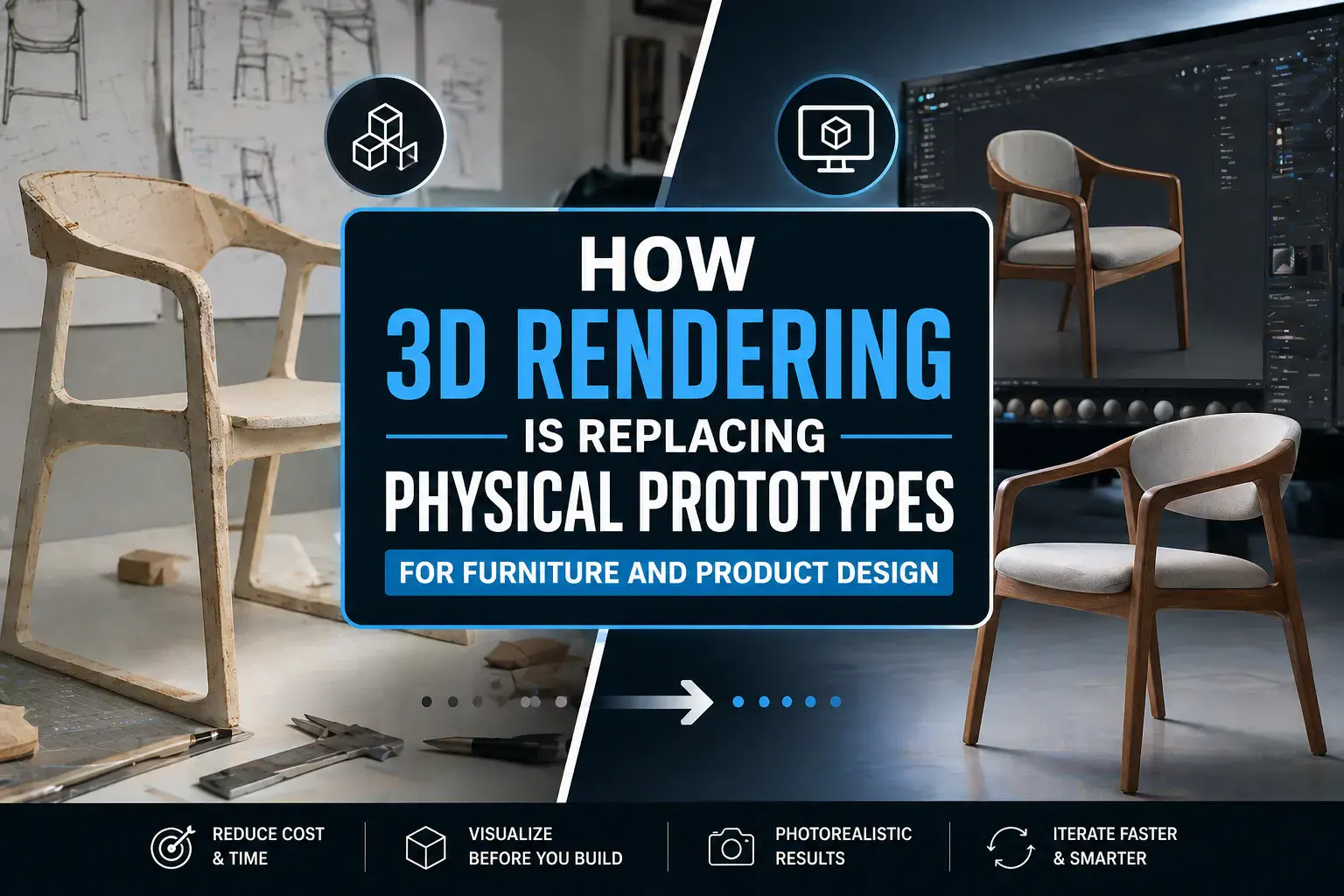
In this modern architectural industry, the way we create furniture and household products has changed a lot. Only a few years ago, the designer had to physically build everything. This traditional process involved:
- wood
- metal
- foam
- countless hours of manual labor
But now, due to digital innovations, things have changed. 3D rendering is one of the best tools for marketing. Because you can virtually look at all the products and make the right decisions. No need to imagine anything!
This is a change in how businesses think about time, money, and the environment. By creating real digital versions of products, the companies can sell their furniture before even a single mold is cast. For that, they rely on experienced architectural rendering services that provide outputs according to their design demands.
Get to know how 3D Rendering Is Replacing Physical Prototypes for Furniture and other product designs!
Understanding the Digital Shift
3D rendering is the process of using computer software to create a 2D image or animation from a three-dimensional model.
In the furniture and product design industry, textures are applied on the digital blueprints. Such as:
- grain of oak
- the soft pile of velvet
- lighting to make it look like a real photograph
The reasons for this transition are numerous and touch every part of the manufacturing process:
- Designers can change the dimensions or shape of a product in seconds without wasting materials.
- The cost of software is significantly lower than the cost of renting a factory space for manual builds.
- Digital models do not require physical storage space
- Colors and fabrics can be swapped instantly
- Marketing teams can start creating advertisements before the factory even starts production.
- Shipping costs for prototypes are eliminated because files are sent through the internet.
- It is much easier to catch design errors on a large monitor than in a rough physical model.
- Digital files can be viewed by teams in different countries at the exact same time.
- Complex shapes can be visualized perfectly on a screen.
Speeding Up the Design Process
One of the biggest reasons designers are moving away from physical models.
It is time!
In the old times, when the designer wanted to see how a new chair would look in three different colors. They had to build three different chairs.
This could take weeks or even months. It used to depend on the complexity and the availability of materials.
But with 3D rendering, this process is shortened to a few clicks.
When a designer works on a digital platform, the feedback from the client is instant. They can easily see how the lights hit the surface at noon or any other time. Moreover, they can see how a table looks with different leg styles. This is the speed that helps to design with creativity and experiment with different styles.
Drastic Cost Reductions
The building of prototypes used to take much time and effort. For a small company, only a 5 sofa prototype could cost thousands of dollars. So,
- Companies no longer need to buy expensive hardwoods just for a “test run.”
- The need for high-end studio photography is reduced because renders look identical to photos.
- Labor costs are lower because one digital artist can do the work of a whole carpentry team.
- Expensive mistakes are found in the digital phase rather than the manufacturing phase.
- Brands can test product demand with renders before spending money on a full production run.
- The insurance costs for shipping fragile prototypes are completely removed.
Infinite Customization and Flexibility
In this modern time, people want products that are specifically designed for their needs. But this personalization is a nightmare for physical prototyping.
3D rendering allows experimenting with anything. Whethe rits is shape, size, color, etc. It allows designers to adapt their products for different cultures and climates.
They can render the same chair in a dozen different virtual rooms to see how it fits into various architectural styles.
Quality and Realism
Advanced technology like ray tracing allows systems to calculate how light bounces off surfaces.
This means that the designers can exactly how a glass coffee table will reflect the light from a window. How cool?
- High-resolution renders allow designers to see every tiny stitch in a piece of upholstery.
- Lighting can be adjusted to simulate any environment
- Multiple camera angles can be generated instantly to show the product from every side.
- Exploded views can be rendered to show how the internal parts of a product fit together.
The Role of Augmented Reality
Augmented Reality is an advanced method of designing a vacant room with interiors and other details.
It allows people to check the height of a piece of furniture in their actual living room.
- Designers can check if the scale of a lamp matches the size of a side table.
- Sales teams can “carry” an entire furniture collection in their pocket on a tablet.
- Retailers can reduce return rates because customers have a better “feel” for the product.
- It creates an interactive experience that makes the buying process more fun for the user.
Conclusion
In short, 3D rendering has replaced the physical prototypes of furniture and product design in a big way! Designers can experiment with different ideas by just sitting on a chair and by using the advanced software. Revit, Unreal Engine, and other platforms are available to generate realistic renderings.