
Richardsonian Architecture Explained: Features, History and Origins
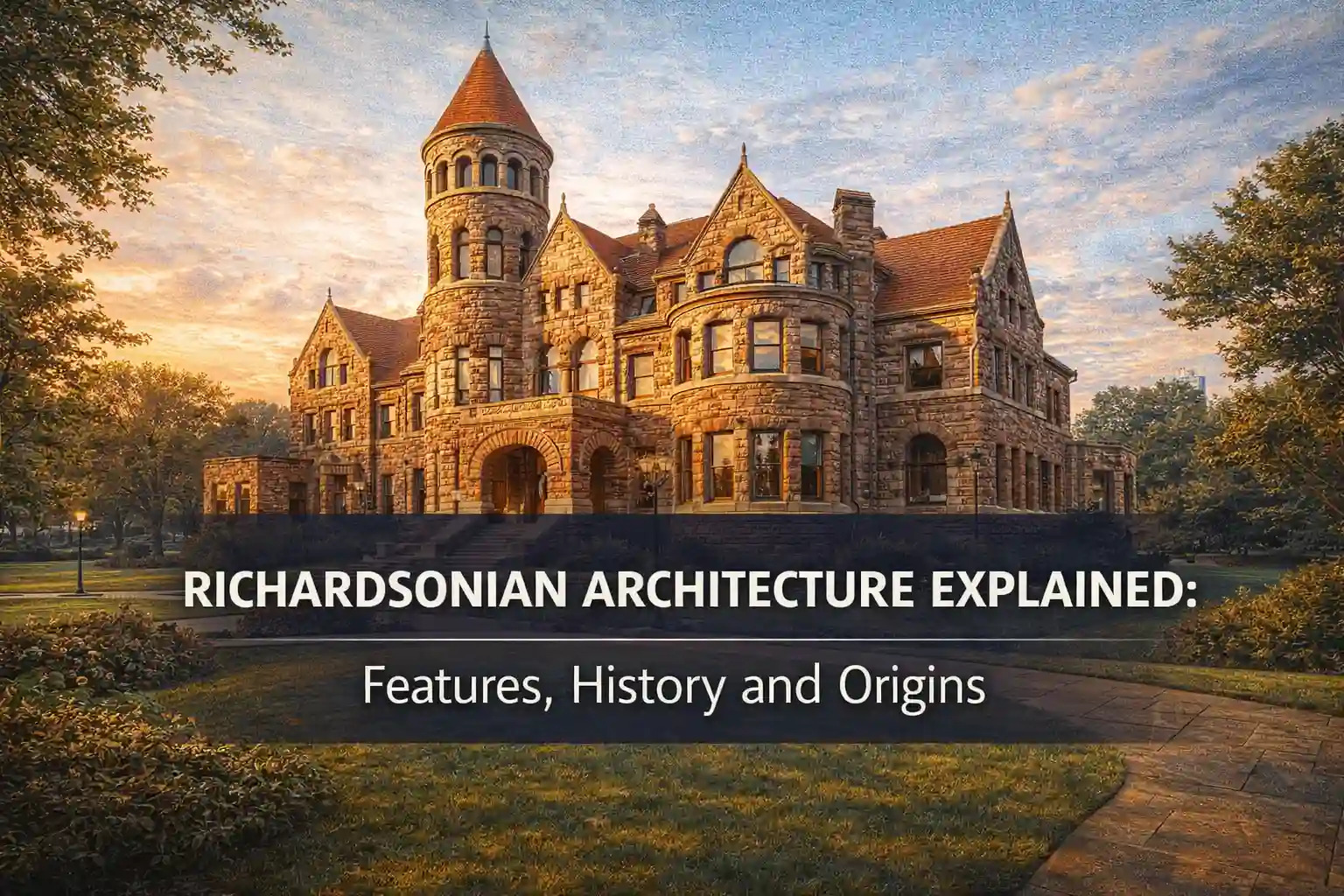
Richardsonian Architecture is considered as the bridge between the ancient medieval and the modern American design. The late 19th century was a time when things were changing a lot. The cities were getting wealthier due to industrial developments. The architectural designs were a combination of Victorian styles and thin-walled wooden structures. In that time, Henry Hobson Richardson created this type of style. It was the collection of stones and arches.
People are now getting attracted to the old styles. They designed their spaces with the help of advanced techniques. They get help from the best architectural rendering services and combine their old and modern concepts in a three-dimensional form. The visualisers provide them with three-dimensional images and animation. This helps in designing unique spaces quickly and accurately.
This guide is to explain the concepts for Richardsonian Architecture and its features, History, and origins!
What is Richardsonian Romanesque?
This architectural style is named after an architect. But most of the styles are named after a historical period.
However, it is a revival of the 11th and 12th centuries that was found in France and Spain. Well, the architect did not just copy the past. He wanted to make it simple and make it unique for Americans.
This architectural styles is defined by its massive weight. Such buildings use heavy stones to create a sense of unshakable stability.
This made it the perfect choice for the banks, courthouses, and libraries of a growing nation.
The Core Features
It is not important to be an architect to understand or spot any Richardsonian building. Look for these “Big Five” characteristics:
1. The Deep-Set Round Arch
The most famous feature is the semi-circular arch. He used low arches. It looked like they were coming directly from the ground. These arches create entrances that focus on the thickness of the walls.
2. Rough-Faced Masonry (Rustication)
He hated smooth stone. His buildings use rusticated stone. This used to give a natural texture to the building. It used to look like it was carved directly out of a cliffside.
3. Polychromy (Multiple Colors)
He used to combine various stone types to create a painting effect. Most commonly a dark red sandstone used for the arches and window trim. The main walls used to be of light gray granite. This prevented buildings to have a gloomy look.
4. Short, Squat Columns
In this style, squat columns were used. They are thick and often topped with intricately carved “foliate” capitals.
5. Cylindrical Towers and Asymmetry
These buildings did not look the same on both sides. They are:
- Asymmetrical
- Have a single circular tower with a conical roof
- Creates a different look from every angle
The History and Origins
The French Connection
Richardson was only the second American architect to study at the prestigious École des Beaux-Arts in Paris.
He saw churches of southern France at that time. He loved its concepts and the heavy use of masonry. Plus, he got inspired by the materials used.
When he returned to the USA, he felt that American architecture was lacking something. He felt that these buildings are heavily reliant on wooden frames and superficial decoration.
The Turning Point
Richardson won the competition to design Trinity Church in Boston. It was a masterpiece.
He used different features such as:
- cross-shaped plan
- a massive central tower
This way he proved that the building can be beautiful and functional at the same time. After that, Trinity Church became a sensation. Suddenly, every city in America wanted this type of building.
Why It Mattered
You can design your buildings with the help of the Top visualization company because they will provide the most accurate 3D designs. However, this style matters due to:
- A Sense of Security
- In a time of rapid social change and industrial unrest, these fortress-like buildings made people feel safe. They looked like they had been there for a thousand years and would stay for a thousand more.
- Civic Pride
- Small towns across the Midwest and Northeast began building Richardsonian libraries and town halls.
- The Father of Modernism
- His focus on “form follows function” and his use of bold shapes deeply influenced Louis Sullivan and Frank Lloyd Wright.
- He taught the next generation that a building’s beauty should come from its structure and materials, not from stuck-on ornaments.
- His focus on “form follows function” and his use of bold shapes deeply influenced Louis Sullivan and Frank Lloyd Wright.
Famous Examples to Visit
| Building Name | Location | Why It’s Special |
| Trinity Church | Boston, MA | The “Birthplace” of the style; incredible color and massing. |
| Allegheny County Courthouse | Pittsburgh, PA | Widely considered Richardson’s finest work; a literal stone fortress. |
| Glessner House | Chicago, IL | A rare residential example that looks like a castle in the middle of a city. |
| Old Toronto City Hall | Toronto, ON | Shows how the style spread internationally with massive arches and a clock tower. |
Final Words!
The Richardsonian architecture time was short. The main reason was the requirement of large amounts of hand-cut stone and expert masons. Plus, they were quite expensive to build. The steel frame construction became a trend. However, the legacy remains. Today, these buildings are often the most like ones in their cities. They remind us of a time when architecture was not just about something perfect. It was all about creating a permanent anchor in a fast-moving world.