Closing the Imagination Gap: How Virtual Staging Solves ‘Aphantasia’ in Home Buying
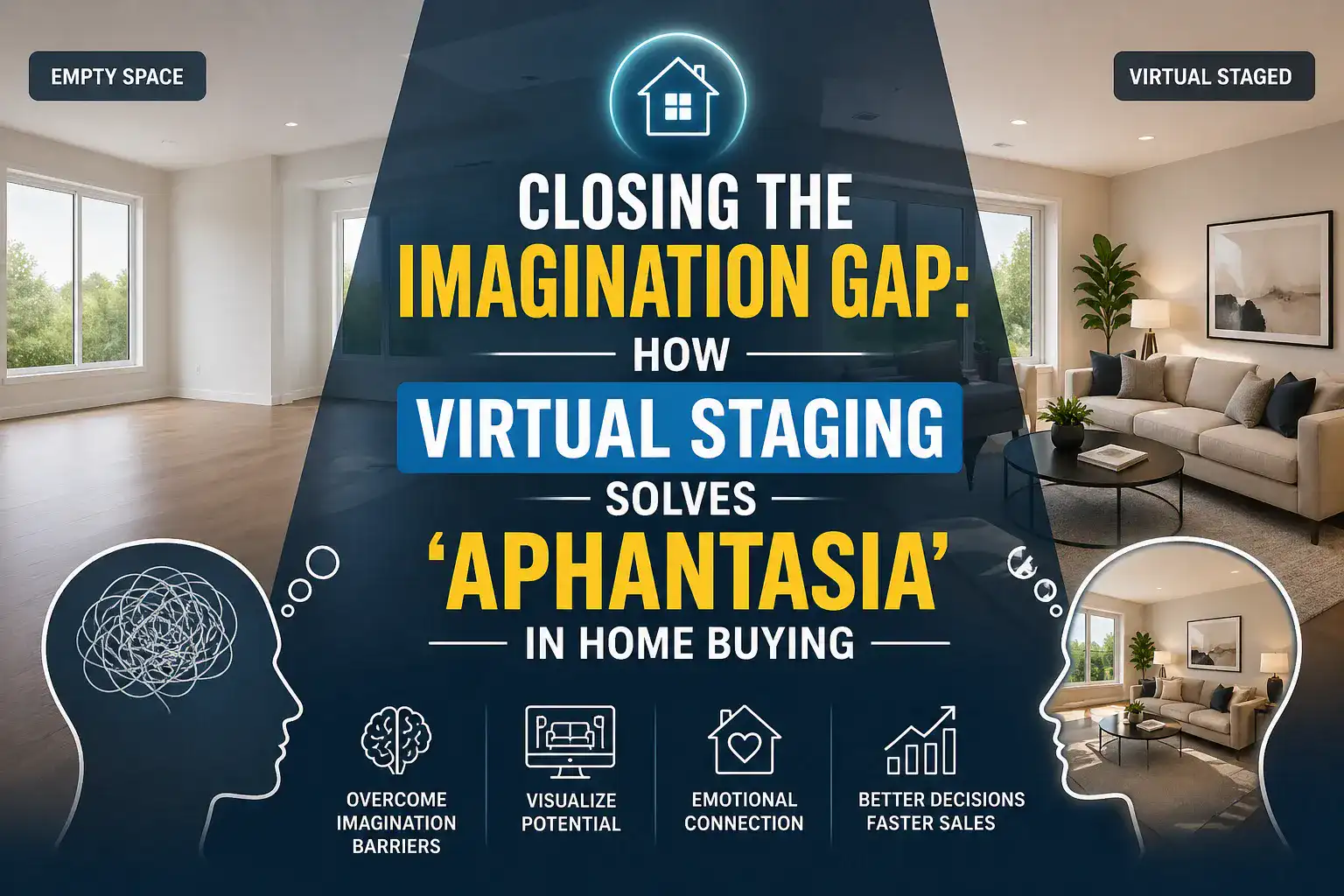
Walk into an empty room and ask someone to picture it as their future living room! However, this situation was okay for everyone for many clients. But for many interested buyers, it was not possible due to clinical aphantasia. It is the inability to form mental images. They could not transform an empty furnished space into a place they could emotionally call home. But now no worries! Because modern tools and methods have made things quite easier. One of the best methods is Virtual staging!
No one has to imagine the designs or the textures on the sofas. Virtual staging helps them visualize home before buying. Real estate companies now get virtual staging services from a reliable architectural studio. Because visualizers use modern tools to design the whole empty space. They convert it into a furnished space with the desired designs, colors, and textures.
Get to know how Virtual Staging Solves Aphantasia in Home Buying!
The Scale of the Problem
It is never possible to create buyer’s emotional connection home by just telling them to imagine their design needs. They are not just investing in square footage!
They are investing in a feeling and a lifestyle. When they do not feel emotionally connected to the space because an empty room offers no visual cue. The interest evaporates quickly.
According to NAR’s 2025 Profile of Home Staging, the investors compare almost 20 homes virtually before visiting just 8 in person.
What does that mean?
This means that the imagination gap is importantly a digital problem.
It was also confirmed by the agents that the 83% of buyers made decisions quickly due to staging.
What Virtual Staging Actually Does
Virtual staging digitally inserts all the required elements in the photographs:
- Furniture
- Lighting
- Décor
- Rugs
- Art
Advanced AI home staging and 3D rendering tools can now do this with photorealistic precision.
Professional virtual home staging services range from $500 to several thousand dollars for luxury properties.
Whereas AI virtual staging can reduce those expenses by up to 97%.
It is true that an empty room forces the brain to do all the interpretive work:
- estimating scale
- projecting furniture placement
- imagining warmth
- Imagining texture
Most people would never invest their mental energy while online scrolling. A virtually staged room eliminates the effort entirely. The brain looks at the finished space and responds immediately. The best of the best benefits are:
- Virtually staged listings sell 75% faster than those without staging technology
- Homes marketed with virtual staging sell for or at the asking price 83% of the time.
- Virtually staged listings receive 40% more views. It generate 31% more inquiries. Buyers spend 20% longer viewing the photos.
- Staged homes sold for an average of between 5% and 20% more than non-staged homes.
The AI Revolution Behind the Curtain
The way we do staging has changed a lot in the last few years. The market for virtual home staging software is really growing. It was worth about USD 0.26 billion in 2024. It will be around USD 1.32 billion by 2033.
This is because virtual staging is getting better with intelligence augmented reality and cloud-based rendering. These things make virtual staging faster, cheaper and easier to use.
Before virtual staging was not very good. It looked fake. You could tell it was done on a computer. The furniture did not look right. The textures were not real.
Now virtual staging is really good. You can barely tell that it is not a photo. Some websites even let you change things around in the room. You can pick furniture change the colors and try out different layouts. This makes it more fun for people looking at houses.
Some rooms are more important than others when it comes to staging. The living room is the important room. 91 Percent of sellers think it is important and about 37 percent of buyers think it is the most important room.
The primary bedroom is also important. 83 Percent of sellers stage this room and about 34 percent of buyers think it is important.
The dining room is also a room that sellers like to stage. 69 Percent of sellers do this.
The kitchen is important to some buyers. 23 Percent of buyers think it is important.
However, Virtual staging helps people see what the rooms could look like. It helps them feel more connected to the house. It is really good at helping people see what the rooms could look like. Virtual staging is a tool for sellers because it helps buyers see the potential of the house.
Conclusion
In short, virtual staging weaponizes the expectations of investors constructively. It gives every listing. It shows the language of aspiration. It helps to close the gap between what a client imagine they can produce and what the property is actually capable of becoming. So, for the millions of buyers who struggle to see an empty room. Maybe due to clinical aphantasia or cognitive fatigue. Virtual staging is a cognitive bridge. So, get photorealistic home rendering for your houses and make the best decisions!