Top 5 3D Rendering Trends Dominating 2026
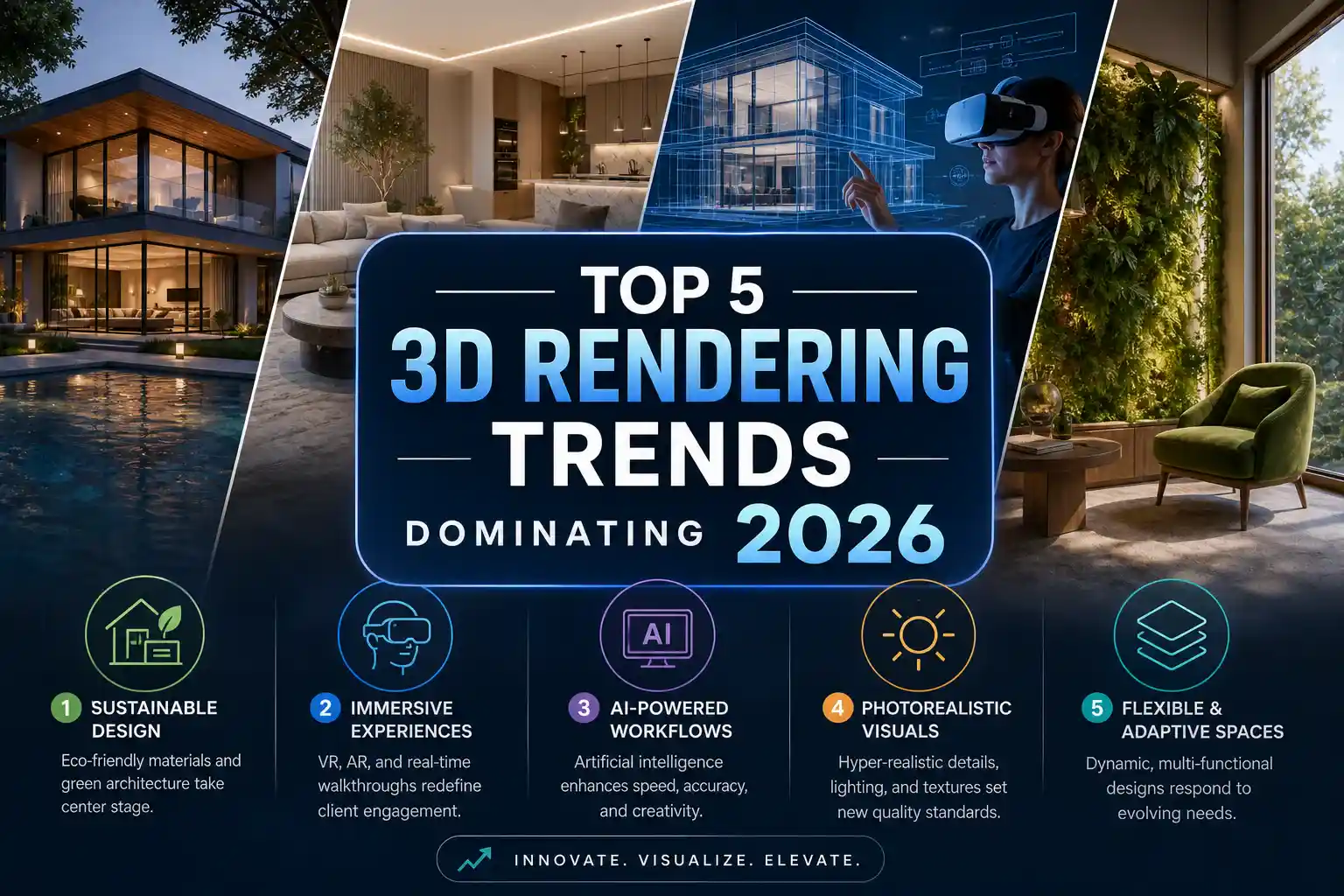
3D rendering in 2026 is one of the dominant professions due to its demand. What once took weeks of manual texturing and back-and-forth client revisions. Now, it just requires a couple of days or sometimes maybe hours!
However, the use of AI and other modern technologies has sparked one of the best changes in the history of architectural visualization.
So, if you are looking to hire a 3D rendering agency. You need to evaluate the 3D rendering prices and other factors. Before that, you need to understand the five dominant rendering trends. It is necessary for you to remain in the competition.
The following Top 5 3D Rendering Trends Dominating 2026 can be a life-changing experience for you!
Top 5 rendering trends dominating 2026
Trend 1: AI Has Moved From Buzzword to Backbone
There is only one thing that is enhancing every corner of the 3D rendering services. It is artificial intelligence!
According to the research, 60% of architecture firms now actively use AI in their processes. Even more, 86% of the users report that it saved a significant amount of time on every project.
This means that AI-generated renderings have taken over traditional photorealistic visualisation.
In 2026, AI workflows will handle the complex projects:
- texture generation via tools like Adobe Firefly and Substance 3D
- intelligent denoising
- post-production acceleration
- automated scene population
The best advantages of using AI in professional studios are:
- Rapid concept generation from text prompts
- AI-powered denoising for cleaner draft renders shared with clients
- Automated texture creation cutting material prep by up to 70%
- Intelligent upscaling of renders without quality loss
- Sky replacement
- atmospheric post-production in seconds
- Generative design exploration
However, 48% of designers still cite unreliable results! This means that human supervision from a top-rated architectural visualization firm is necessary for perfect deliverables.
Trend 2: Real-Time Rendering Is Now the Industry Standard
The debate between real-time rendering vs. offline rendering in 2026 has largely been settled.
Various designers now use real-time rendering daily. They use advanced software such as:
- Unreal Engine 5
- Twinmotion
- Enscape
They are becoming the backbone of next-gen rendering technologies in professional studios.
Well, offline rendering hasn’t disappeared. The best architectural visualization companies in 2026 apply a hybrid approach.
They use real-time engines for client engagement. Plus, they use offline path-tracing for final cinematic deliverables.
The benefits of real-time rendering for clients and studios are:
- Instant material and lighting swaps during live presentations
- Immersive design reviews that reduce costly late-stage change orders by 30–40%
- Faster internal decision-making without waiting for new render batches
- Supports seamless integration with AR and VR workflows
- Compatible with BIM and MEP design
- Dramatically shorter project turnaround for pre-construction marketing
Trend 3: Digital Twins Are Redefining Construction Communication
What is a Digital Twin in construction?
Expensive middle construction errors and miscommunication over blueprints are the biggest nightmares for an architect in 2026.
But now they use digital twins as a replacement for traditional 2D blueprints. Because it helps them communicate easily. Digital twins use life data feeds. It evolves throughout the entire asset lifecycle.
If you are not still using this latest method, then you should go with it because it delivers:
- 1:1 virtual replica built directly from CAD and BIM files
- Real-time clash detection
- Physically accurate lighting
- Interactive VR floor plans
- Full MEP design-to-budget rendering workflow integration
- A permanent digital asset for long-term facility management
Trend 4: Cinematic Storytelling Has Replaced Simple Photorealism
The time of just realistic renders is over. In 2026, the clients not only want the visuals to be accurate. They also want to feel the space.
However, the most powerful shift in architectural rendering trains this year is cinematic storytelling.
It consists of renders and animation that communicate mood and emotional experience
Cinematic storytelling in architectural animation means working on every frame as a scene from a film. If you want to achieve such visuals, then get Professional photorealistic rendering services now!
There is also the use of biophilic design rendering for green buildings. It is growing rapidly in the industry.
The studios are asked to render not just the building, but to create a relationship between the building and nature
Elements of cinematic look are:
- Lifestyle staging
- Biophilic elements
- Sustainability overlays
- Atmospheric post-production
- Brand-aligned visual identity baked into every frame
Trend 5: Immersive VR and Interactive Experiences Are Democratizing
The last big change is that VR and AR are now for everyone!
This means that it is not only for expensive luxury projects.
In 2026, even small businesses can have these walk-throughs. Real estate agents can now show virtual tours to their clients. They do not need a headset or no one has to travel.
However, AR is even more helpful. The best toolkit in 2026:
- Browser-based VR walkthroughs
- Mobile AR for on-site visualization
- 8K high-fidelity textures with ray-traced lighting
- Integration with digital twins
- 360-degree panoramas
Conclusion
The best 3D rendering companies in 2026 are not those with the fastest hardware. They are the ones who are best suited to use AI and other trends to deliver the best quality to their clients. These architecture rendering trends can let you stand out in the industry. Make sure that your client feels the space before it exists.