A Builder’s Guide to 3D Rendering Costs for Single Story Houses
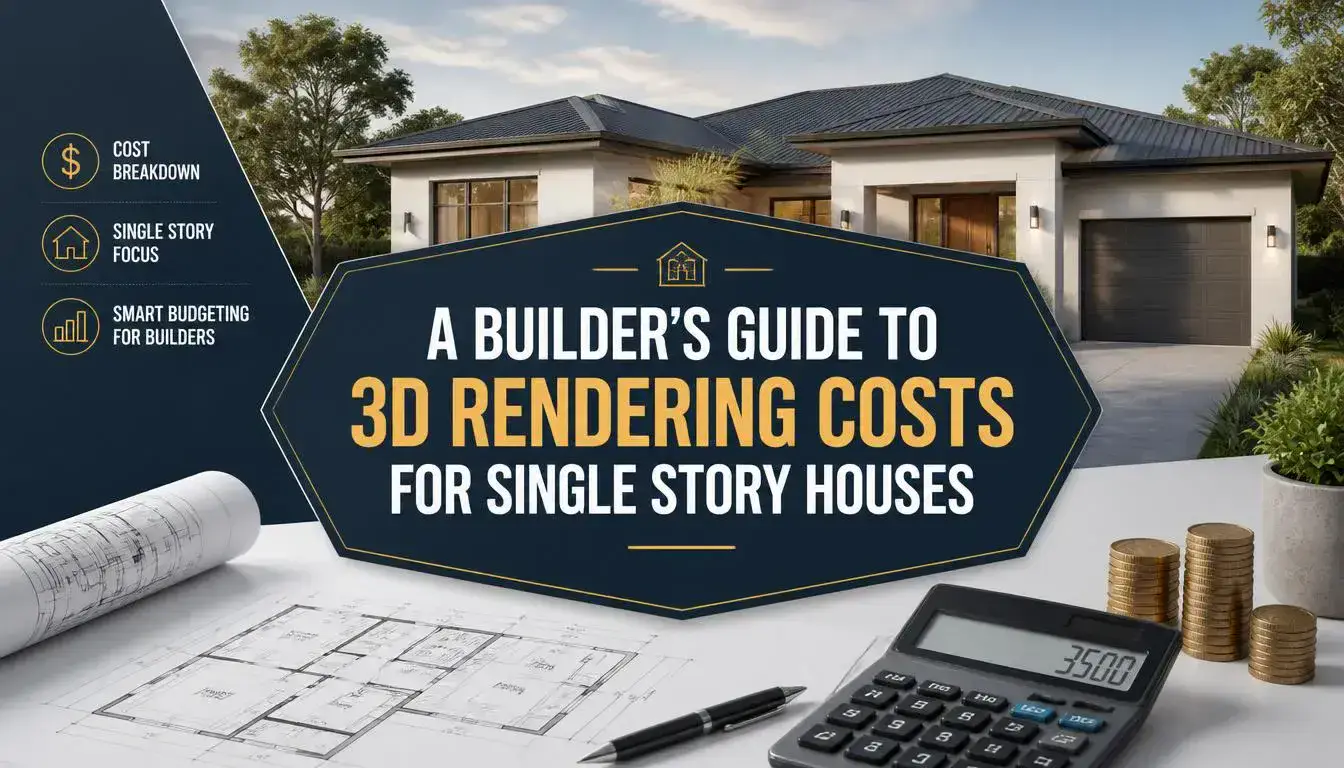
3D rendering has changed from a premium add-on to a standard expectation for single-story house projects. The cost of getting it right is one of the most misunderstood line items a builder faces. The quotes are directly linked to the studio, the software and the level of detail. A clear framework is necessary to understand the price differences. Builders either overpay or underspend on deliverables that fail to win client approval at the design stage.
We have written the real cost variables behind 3D rendering for single-story houses in this guide for you. It ranges from square footage to file delivery formats. It is important for the builders so that they evaluate the quotes precisely and make rendering decisions that protect their margins without compromising the client presentation.
What Does a 3D Rendering for a Single Story House Actually Cost?
The right answer is that it depends on various factors you can control. Let us provide you with an overview:
|
Project Scope & Type |
Pricing Range | Details & Inclusions |
|
Per-Image Cost (General) |
$1,000 – $3,000 | Price depends on scale |
| Single-Family Home Package | $1,200 – $2,500 |
Includes 3 exterior views |
| Community-Context Package | $2,800 – $4,500 | 3 exterior views placed within a master-planned community |
| Multi-Building Developments | $3,000+ |
complex modeling |
| Interior Renders | $500 – $2,200 |
Offers good realism |
Walkthrough animation video have changed the marketing game in the industry.
The 6 Core Factors That Drive Your Rendering Price
1. Project Complexity
Complexity is one of the major factors that increases the rendering expense. A simple single-story house with flat design and basic furnishings will cost less than a design with complex architectural details. The most common cost-increasing factors are:
- Custom or non-standard rooflines
- Glazing systems and large window walls
- Mixed exterior cladding materials
- Covered alfresco areas, pergolas, and pool zones
- Split-level or stepped slab configurations
2. Level of Realism
This factor creates the widest price gap.
A concept-level render might cost $250. But photorealistic residential rendering to get pre-sales might cost $5,000 for a single image. Most investors choose a middle-range render for early design development or client approvals.
|
Quality Tier |
Cost Per Image | Visual Characteristics & Deliverables |
|
Concept / Schematic |
$250 – $500 | Basic geometry |
| Standard Residential | $500 – $1,800 |
Accurate material textures and good quality lighting |
| Photorealistic / Marketing | $2,000 – $5,000 |
Full post-production, advanced atmospheric effects |
3. Site Context and Environment
The aerial shots require 3D neighborhood modeling. It costs 35 to 50% more than simplified backgrounds.
For a single-story house, you may have to include the surrounding structures. This is needed to get approval from the government. Many builders do not expect this extra expense. The most common cost considerations are:
|
Complexity Level |
Cost Impact |
|
Minimal Landscaping |
Lowest Cost (Standard baseline) |
| Full Soft Landscaping |
Moderate Addition |
| Hardscaping & Context |
Significant Addition |
| Full Aerial Environment |
Highest Cost |
4. Number of Views Ordered
It is common that a single render costs more than multiple renders. It decreases the price by 15 to 25% because artists can maintain consistent styling across views. Commonly, for most single-story builds, a package of three to five exterior views plus two or three key interior scenes is popular. The smart bundling strategy is:
- Front elevation + 45° corner view = essential exterior minimum
- Rear yard / alfresco view = strong lifestyle selling point
- Master bedroom or open-plan kitchen/living = highest interior ROI
- Aerial bird’s-eye = best for estate and acreage properties
5. Turnaround Time
The work that requires quick delivery in less than 7 days costs 25 to 50% more. If your marketing timeline allows it, you can plan renders four to six weeks out from your launch date.
6. Who You Hire
Freelancers charge $400 to $1,000 per render. It depends on their experience and how much modeling is involved. If working hourly
If working hourly, expect $50 to $150 overall. Experienced studios charge more, but they include:
- structured revision rounds
- project management
- consistent output quality
Is the AI Rendering Tool useful?
AI platforms now cost as little as $0.50 to $5 per image or $10 to $120 per month. However, accuracy is compromised in such tools, but they are suitable for early-stage thinking. Almost 67% of architects now use AI tools for initial concepts.
When AI rendering makes sense:
- Internal design development and concept testing
- Quick client mood board presentations
- Social media content with a casual aesthetic
- Exploring material and color options before committing to a full render
When to stick with professional rendering:
- Council and planning authority submissions
- Display home and land estate marketing
- Presales campaigns and investor presentations
- Award entries and architectural publications
Practical Budgeting for a Single Story Build
Here is a realistic spending guide for the most common single-story house scenarios:
Spec or project home (standard):
- 3 exterior views + 2 interiors: approximately $2,500 to $4,500
Custom residential (mid-range complexity):
- 4–5 exterior views + 3–4 interiors: approximately $4,000 to $8,000
Luxury custom or display home:
- Full package with aerial, twilight, and animation walkthroughs: $10,000 to $20,000+
Conclusion
3D rendering costs for single-story houses are not fixed. It is an investment that responds directly to what you ask of it. It is important to know about your audience and build your render package around what that audience needs to see. After that, match the realism level to the decision being made. Order your drawings in large groups to get lower prices. Once you are done, give all the materials to the studio so that they can do their job quickly.