How 3D Rendering Helps Win Retail Store Design Approvals
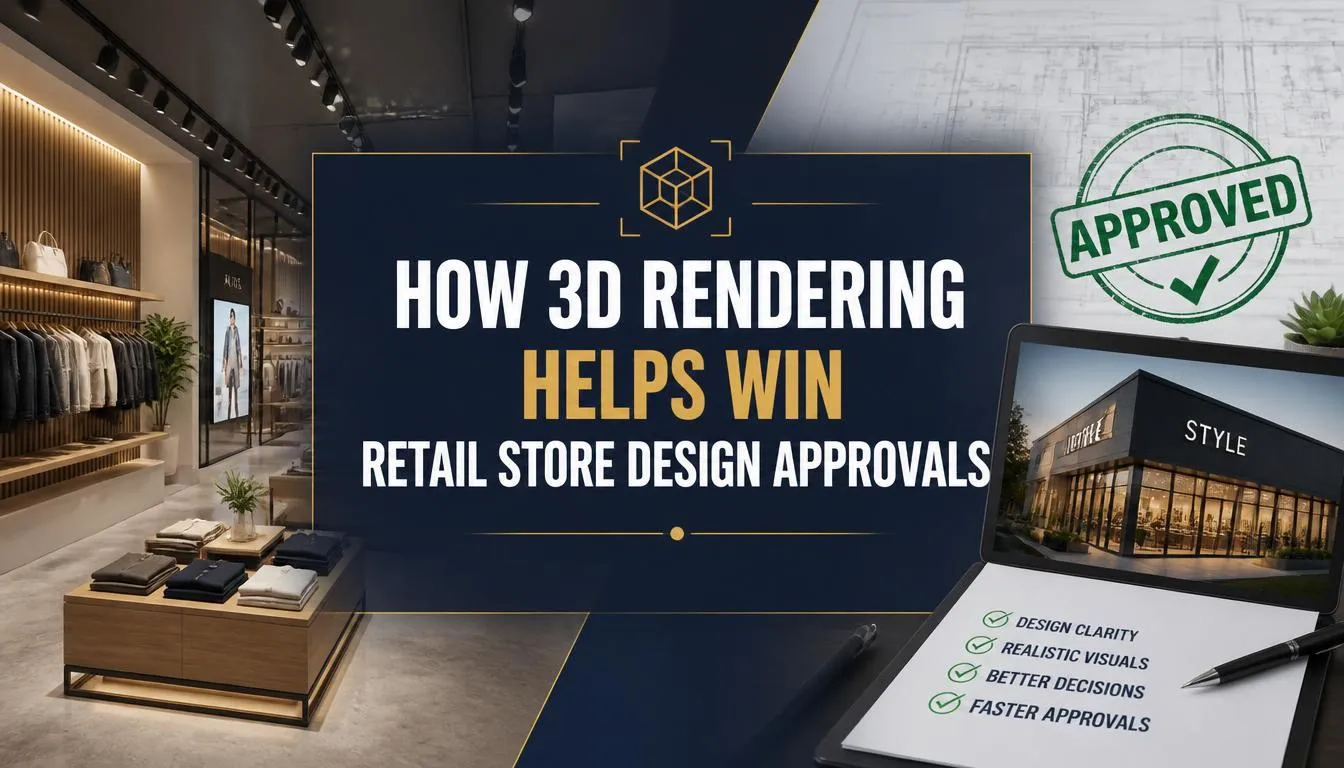
The retail industry is not only about the products on the shelves. It is a complete brand experience. Before any client steps through the door, a big hurdle is getting approval from investors. Old 2D blueprints and flat designs lead to costly misunderstandings and delayed timelines. 3D rendering for retail store design helps convert simple concepts into photorealistic experiences. The decision-makers can see, feel, and confidently say yes to.
3D rendering for architects is considered as one of their best design tools for quick approvals and increasing sales. Otherwise, old methods and flat drawings used to take days and weeks to complete a single project.
Get to know how 3D Rendering Helps Win Retail Store Design Approvals
Why Traditional Design Presentations Fail
- 2D drawings are too abstract for non-technical stakeholders
- Sketches and mood boards fail to communicate lighting or material quality
- Multiple revision rounds add weeks of delay
- Misaligned expectations between designers and clients
- Presentations lack the emotional impact
What Retail Store 3D Rendering Actually Delivers
With the help of an experienced architectural rendering company that uses computer-generated imagery (CGI) and architectural visualization software. You can get photorealistic presentations before even a single work is done on-site. The services they offer help the clients view and check the entire furniture layout and other design details.
With life-like lighting and materials, a 3D store visualization builds confidence during planning. It lets the project members experience exactly how the space will feel to shoppers.
What a high-quality retail 3D render includes:
- Photorealistic interior views showing product displays, etc.
- Exterior renders shows facade
- Floor plan visualizations maps customer flow
- Animated walkthroughs and 360° virtual tours
- Day/night lighting scenarios to demonstrate ambiance shifts
- Multiple design variation options (colors, layouts, materials) shown side by side
How 3D Rendering Directly Accelerates Design Approvals
1. It Eliminates Stakeholder Uncertainty
Uncertainty is the biggest problem. According to industry research, 3D rendering eliminates uncertainty in construction plans. The professional rendering companies help to remove ambiguity and align everyone involved.
2. It Makes Investor Pitches Far More Persuasive
High-quality 3D renders allow brands to showcase a store design concept to investors. This creates a realistic image that conveys the designer’s vision and improves chances for project approval.
That 3D render can make the concept real and achievable. It is always easier to say yes to something you are able to see and almost touch.
3. It Supports Planning and Regulatory Approvals
Exterior 3D rendering is considered as the top strategy to get approvals. Retail building renderings help brands analyze lighting and material choices with accuracy. Plans are approved through atmospheric rendering and it also makes sure that the exterior experience aligns with the interior concept.
4. Virtual Walkthroughs Create Immersive Decision-Making
When investors and team members can literally walk through a new concept. The decisions are made more swiftly. Just by using a mouse, one can walk over the whole building.
Benefits of virtual retail walkthroughs:
- Franchise directors can evaluate brand consistency across multiple proposed store formats
- Mall landlords can assess how the store will draw foot traffic from common areas
- Executive teams can give informed feedback without needing technical design expertise
- Remote stakeholders can participate in reviews without being physically present
- Design flaws — awkward transitions, poor lighting zones — are caught before construction
The Cost Efficiency Argument That Wins Boardroom Buy-In
3D rendering protects budgets other than approvals. Early visualization helps prevent costly changes. This reduces financial risks and delays. Moreover, 3D renderings provide clear visuals. 360° walkthroughs or VR tours are most common among investors.
Cost advantages of 3D rendering in retail design:
- Design changes made during the render phase cost a fraction of post-construction revisions
- Fewer physical mockups or sample installations are required for stakeholder reviews
- Approval cycles can be shortened significantly, reducing time-to-open for new locations
- Marketing materials can be produced before the store is built
- Contractors use photorealistic renders as precise build guides, reducing on-site ambiguity
Types of 3D Rendering Used in Retail Design Approvals
|
Render Type |
Primary Use in Approvals |
|
Interior CGI Stills |
Investor pitches, franchise board reviews |
|
Exterior Building Renders |
Planning authority submissions, landlord approvals |
|
Floor Plan 3D Renders |
Layout functionality reviews, regulatory compliance |
| Virtual Walkthrough / 360° Tours |
Executive sign-offs, remote stakeholder reviews |
| VR Immersive Experiences |
High-stakes franchise or multi-location rollouts |
| Day/Night Lighting Renders |
Ambiance approval, signage visibility assessments |
Conclusion
Advanced 3D visualization has changed the way how retail spaces are planned and presented. This helps the brands to communicate concepts with greater accuracy. In this competitive industry where every week of delay costs extra money and missed approval derails a launch. 3D rendering is your saviour. Additionally, it is the standard operating procedure for retail design teams to obtain confident approvals. So, now the thing is how quickly your team can apply it in your processes.