3D Rendering vs Photography: 7 Reasons CGI Is Replacing Traditional Photos in Architecture Marketing
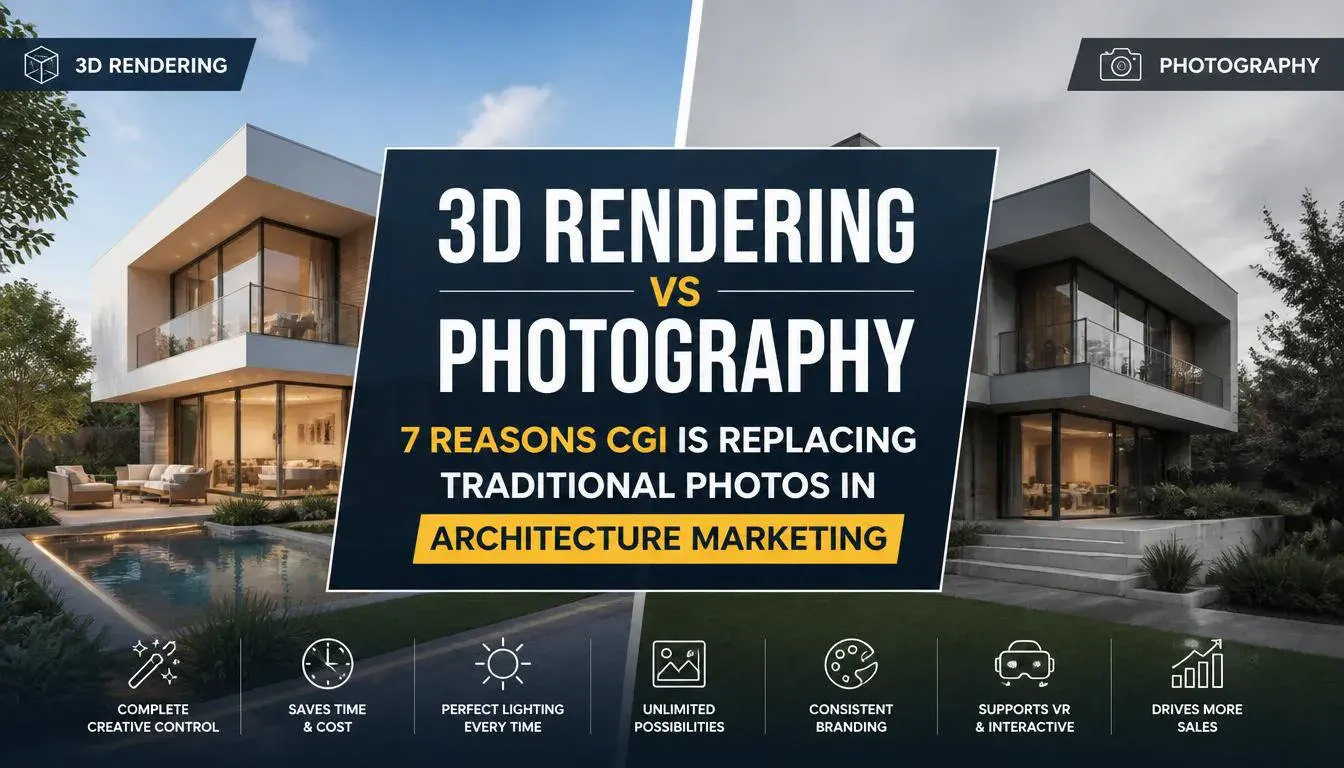
The requirement of cameras and expensive post-production is now being replaced by advanced CGI and photorealistic 3D rendering. If one compares 3D rendering vs photography. One will get a clear view that CGI has replaced traditional architectural photography. The market for 3D visualization and rendering is growing in routine. Most companies have shifted towards the use of modern methods that emphasize exploring the top seven reasons CGI is replacing traditional photos.
From the pre-construction phase to presenting proposals to the clients for approvals. Rendering has become quite common. Investors rely on experienced 3D interior rendering services because expert visualizers provide realistic visuals. It mimics the exact scenario that looks real. It seems like someone has taken a photograph of a real place.
What Is Architectural 3D Rendering?
Architectural 3D rendering is a technical process of creating digital scenarios. It is also named as architectural visualization or CGI imagery. The scenarios are designed by using modern tools and software. Experts generate real-like images and animation of the interior, exterior, or the desired space.
Tools like Autodesk 3ds Max, V-Ray, Lumion, and others and famous for this visualization process.
On the other hand, architectural photography requires a completed physical structure and professional equipment. The constraints are many. The control is limited.
Exploring 7 reasons why CGI is replacing traditional photos
Reason 1: CGI Markets Buildings Before a Single Brick Is Laid
Real estate companies market their properties before even a single material is bought. It is one of the most powerful photorealistic CGI assets for architects and investors. The benefits are:
- Traditional photography requires a finished building
- CGI allows full marketing campaigns before ground-breaking
- Developers can launch pre-sales and attract investors
- Architecture firms can showcase project types even without a completed portfolio example
Reason 2: Total Creative Control
One of the most difficult things in photography is that you do not have control over natural conditions. A gray sky in the foreground can ruin an excellent shoot.
But, 3D rendering eliminates such issues entirely.
- Set the sun angle and hour to the most flattering time of day — every single time
- Replace winter-bare trees with lush summer foliage instantly
- Remove unwanted neighboring structures
- Remove visual clutter from the scene
- Work on golden hour or dramatic nighttime illumination
- Test multiple seasonal atmospheres
Reason 3: Lower Long-Term Cost
You will experience a cost difference between CGI and traditional photography. But when you look at the benefits, the economics increasingly favor rendering.
Traditional architectural photography costs include:
- Professional photographer fees ($1,500 – $10,000+ per shoot)
- Location staging
- Multiple shoot days for different angles or lighting conditions
- Post-production retouching and editing
- Reshoot costs if design elements change
CGI rendering advantages:
- A single 3D model can generate unlimited images from any angle, in any lighting
- One set of CGI visuals can be repurposed across websites, brochures, investor decks, social media, and print
- Revisions take hours, not weeks
Reason 4: Photorealistic Quality That Rivals
In recent years, the best development is how convincingly CGI images replicate. Moreover, it exceeds the quality of professional photography.
- Physically Based Rendering technology simulates how light interacts with real materials
- AI rendering enhancements improve detail and reduce noise
- Professional 3D artists create CGI which is looks not even a little different from real-life photography
Reason 5: Use with Virtual Reality & AR
Investors and planning committees increasingly expect immersive experiences. CGI is the foundation that makes them possible. These experiences now include:
- 360-degree virtual tours on any browser or VR headset
- Augmented reality overlays that place unbuilt structures into real-world environments via smartphone
- Real-time 3D configurators let the investors customize designs
- Interactive walkthroughs that allow investors to walk through a building before construction
Reason 6: Unlimited Flexibility for Iterative Design and Client Collaboration
The architecture domain is dynamic. Design changes and client feedbacks directs to revisions. CGI supports this process in a way that traditional photography categorically cannot. It may include:
- Change a cladding material from brick to timber in minutes
- Present multiple design variants to a client for comparison
- Align all teams around a single visual reference
- Adjust interior layouts, furniture, or color schemes without staging
- Generate versioned assets for planning applications and public consultations from the same base model
Reason 7: Credibility
CGI is replacing traditional photography for brand positioning and consistent digital marketing.
- A single set of CGI imagery maintains visual consistency across all touchpoints:
- website hero images
- LinkedIn banners
- print brochures
- billboard advertisements
- video walkthroughs
- Posting CGI renders of projects in progress of completed buildings shows design intent
- Architecture firms can showcase portfolio diversity using rendering to show their capability
- High-quality visuals improve social media engagement and improve digital ad performance
CGI vs traditional architectural photography Summary
|
Factor |
3D Rendering (CGI) | Traditional Photography |
|
Pre-construction use |
Full capability | Not possible |
|
Creative control |
Total | Limited |
|
Lighting/environment |
Fully controlled | Weather-dependent |
|
Long-term cost |
reusable |
Recurring shoot costs |
| Iteration speed | Minutes |
Days to weeks |
| VR/AR integration | Native |
Not applicable |
| Design flexibility | Unlimited |
None post-shoot |
| Authenticity | Digitally created |
Photographic truth |
Conclusion
The architectural visualization market shows you a clear concept. CGI is no longer an optional tool. In many practices, it has become the primary marketing medium. For architects and real estate marketing professionals who have not yet changed their workflows. They must get photorealistic 3D rendering for their properties and get maximum attention online. Keep in mind that the competitive gap is growing. The firms winning the best projects and attracting most investors are those that have CGI as their main marketing asset. In this modern world, the architecture is now changing in the pixels. Start practicing advanced methods and win more projects.