3D Rendering for Airbnb & Short-Term Rental Design
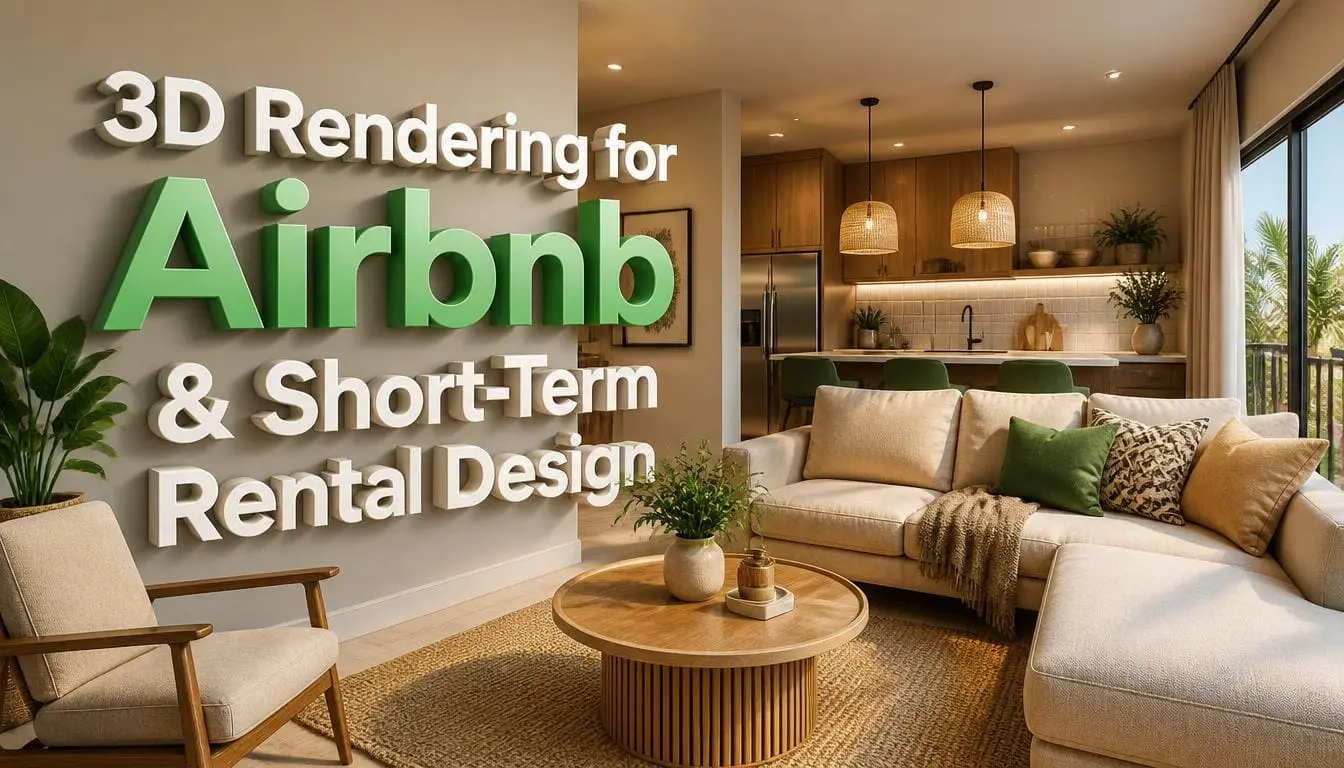
3D rendering for Airbnb turns a floor plan or an empty room into a photorealistic image before you buy a single sofa. Short-term rental hosts use it to test layouts, compare finishes, and market a property that isn’t furnished yet. One render costs less than one wrong furniture order. You can see the mistake on the screen rather than find it after the furniture arrives.
Worried you’ll furnish a room guests scroll past? 3D interior rendering services let you see every option first, then buy only what works.
What Is 3D Rendering for Airbnb?
A 3D render is a computer-made photo of a room. It shows a space before it is built or furnished. A 3D artist models the walls, windows, furniture, and light, then outputs a still image, a 360° panorama, or a 3D floor plan.
Most 3D residential rendering services build the scene in software such as Blender, 3ds Max, or D5 Render, then they add realistic lighting and materials to make a room look like a real photo. That’s why a good render reads as a listing photo, not a video game.
Short-term rental design carries one extra job that home design doesn’t: the room has to look good in photographs. Guests often choose a property based on its listing photos. Renders let you check that months early.
What’s the Difference Between a Render and Virtual Staging?
Virtual staging adds furniture to a photo of a room that already exists. A render builds the room itself so you can move a wall, not just a chair.
That difference decides which one you need. If your property is furnished and photographed, virtual staging is cheaper and faster. If the space is empty, mid-renovation, or still on paper, staging has nothing to work with; you need a render.
Plenty of hosts pay for the wrong one. They book virtual staging for a property that hasn’t been built yet, then discover it can only decorate a room that already exists. Before you spend, you should understand what virtual home staging is. Book it for a property that hasn’t been built yet, and you get nothing back.
Does 3D Rendering Actually Get More Bookings?
Yes, and the research put numbers on it.
A Management Science study by Zhang, Lee, Singh and Srinivasan tracked 7,423 Airbnb properties for 16 months. They found that listings that moved to verified professional images had 8.98% higher occupancy than listings using photos taken by hosts.
What the photo shows matters even more than how it was shot. He, Li, and Wang, publishing in the International Journal of Research in Marketing in 2023, found that featuring the living room in the cover image lifted the booking rate by 35%. In their sample, a 16-night year-end holiday window at an average nightly rate of $130 worked out to $728 in extra revenue. The dollar figure is dated; the 35% lift is the number that still applies.
Staging research points the same way. In the 2025 Profile of Home Staging from the National Association of Realtors, 83% of buyers’ agents said staging helped people picture themselves in a space. Nearly half of the listing agents said it cut time on the market.
Renders let you design that cover shot on purpose before anyone lifts a hammer.
How Much Does a Render Cost for a Rental Property?
You can expect $250 to $2,500 per interior image in 2026. The price depends on detail and studio.
| Deliverable | Typical 2026 price | Best for |
| Single interior still | $250–$2,500 | Testing one room |
| Photorealistic hero image | $600–$2,500 | Cover photo, marketing |
| 3D floor plan | ~$300 per floor | Explaining an odd layout |
| 360° panorama | $800–$2,000 | Direct-booking website |
| Walkthrough animation | $2,000+ | Launches, investor decks |
Ranges come from 2026 studio pricing guides such as NoTriangle Studio, which puts interiors at $600–$2,500 per image.
A four-image package for a two-bedroom unit costs around $1,200 to $4,500. Custom cabinetry, night scenes, and extra views push it higher. Most quotes include one or two revisions, so confirm that in writing.
What Should You Render First?
Render the rooms guests judge fastest, in this order:
- Living room: This becomes your cover photo.
- Kitchen and dining: Layout mistakes here cost the most.
- Primary bedroom: Check bed size against walking space.
- Bathroom: Tile, vanity, and lighting decisions.
- Outdoor area: Hot tub, patio, and fire pit placement.
Skip closets and hallways. They rarely change a booking decision. If the budget covers one image only, make it the living room. That’s the shot guests judge and the room your co-host, contractor, and designer argue about most. One Airbnb interior design rendering settles it.
Can You Use Renders in Your Live Listing?
Use them before the space exists. Then swap them with real photos.
Airbnb expects listing images to show the actual property, so renders belong on pre-launch pages, direct-booking sites, and investor decks. Label them plainly: “Artist’s render, furniture arriving in March.”
The window between closing on a property and welcoming your first guest is where most hosts lose money, and it’s exactly where vacation rental 3D visualization pays.
What Do 2026 Numbers Say About Design-Led Listings?
Design matters more this year because supply stopped racing ahead of demand. AirDNA’s 2026 Midyear Outlook forecasts U.S. occupancy averaging 57.4%, with demand and listings both growing 2.7% and RevPAR up 2.9%. Growth now comes from rates, not new rooms. And rates get earned in the photos.
Guests book later now, and they compare more listings before picking one. You can also check the 2026 short-term rental design trends data to see what they want. Quiet bedrooms, good beds, and blackout blinds have rising demand.
Biophilic design Airbnb rooms use plants, wood, and natural light to feel calm. A render lets you test how many plants a room needs, so it looks fresh instead of crowded.
The Bottom Line
3D rendering for Airbnb is a decision tool first and a marketing tool second. Test the layout on a screen, remove the bad ideas early, and launch with visuals that match the stay you’re promising. Your furniture budget goes further when you do not have to return the wrong items.
Frequently Asked Questions
Q1: How does 3D rendering help design an Airbnb?
It lets you test decisions before you spend. A render shows furniture scale, walking space, and sightlines. Moving a sofa or an island takes a day on screen and a month in real life. You also get a marketing image before the room exists.
Q2: What design features increase Airbnb bookings?
Seating for everyone the listing depicts. A four-guest listing with two dining chairs reads as a mismatch, and guests notice it in photos before they notice anything else. After that: soft lighting instead of a single ceiling fixture, blackout curtains, and a real dining table rather than a breakfast bar. Add one memorable element such as a view, a reading nook, or a piece of local art. Photograph the living room first, but design it for a group, not a couple.
Q3: Can AI Tools Replace a Rendering Artist?
For quick style tests, yes. AI platforms produce fast mood images for $20 to $400 a month. They still get exact product models, custom cabinetry, and precise dimensions wrong. Use AI to narrow the direction, then hire an artist for the final images you'll market with.
Q4: How much does it cost to renovate a short-term rental?
Furnishing a mid-range two- or three-bedroom costs $18,000–$35,000 in 2026. Construction is separate: Angi puts the average kitchen remodel at $26,941 and a whole-house remodel at $52,000. A render costs a fraction of that and protects the rest of the budget.
Q5: Do I Need a Floor Plan to Get Started?
A dimensioned floor plan is ideal, but not required. Artists can work from a rough sketch with accurate measurements plus phone photos of each corner. Guessing at dimensions is the main reason renders come back wrong, so measure ceiling height and window positions carefully.
Q6: Can 3D rendering replace Airbnb listing photos?
No. Airbnb wants your photos to show the real place. Use renders while the space is empty or still being built, and label them clearly. Swap in real photos when you go live. Unlabeled renders lead to "not as described" complaints, refund requests, and weak reviews.
Q7: What design trends boost Airbnb ADR in 2026?
Features that support longer stays. A real desk and chair, a good mattress, and a kitchen someone can actually cook in. These let remote workers and families book, not just weekend couples. Longer stays mean more revenue per booking so you can charge more per night.
Q8: Is a 3D render the same as a Matterport tour?
No. A Matterport tour scans a room that already exists and puts real photos together. A render is built from scratch in software, so it works on empty or unbuilt properties. Many hosts use both: renders during renovation and a scan once the furniture arrives.